The Grid Blog

    Real talk about preparedness — no fear-mongering, just practical steps for real families.

    For 24 Years, the Hurricane Forecast Map Stopped at the Coastline. In 2026, It Finally Went Inland.
    August 10, 2026·GridPrepped Team

    For 24 Years, the Hurricane Forecast Map Stopped at the Coastline. In 2026, It Finally Went Inland.

    NOAA just added inland watches and warnings to the hurricane forecast cone for the first time. Here's why that matters if you don't live on the coast.

    NOAA just rebuilt the hurricane forecast cone to include inland watches and warnings for the first time since the graphic debuted in 2002. The reason isn't subtle: the deadliest hurricane since Katrina did almost all its killing 300+ miles from the beach. The cone used to end where the coast did Sin

    Read Full Post
    Four Weeks After Iniki, Only 20% of Kauai Had Power Back. The Wind Wasn't the Reason.
    August 14, 2026·GridPrepped Team

    Four Weeks After Iniki, Only 20% of Kauai Had Power Back. The Wind Wasn't the Reason.

    A Hurricane Warning is up for Hawaii Island. Hawaii's six grids aren't connected to each other — and that's what sets outage length, not wind speed.

    As of Friday morning, August 14, 2026, the National Weather Service has a Hurricane Warning in effect for the Big Island of Hawaii — Kona, Kohala, and the island's east, north, south, southeast, interior, and summit zones. Tropical Storm Lala was about 455 miles east-southeast of Hilo with 60 mph su

    Read Full Post
    Hawaii Island Averages Nine Hours Without Power a Year. Parts of It Are Now Looking at Weeks.
    August 17, 2026·GridPrepped Team

    Hawaii Island Averages Nine Hours Without Power a Year. Parts of It Are Now Looking at Weeks.

    Hawaiian Electric is telling rural Hawaii Island customers to expect weeks. Federal data shows why "a few days" is the wrong number to plan around.

    On Sunday morning, Hawaiian Electric published a sentence that most utilities try very hard never to write: customers should "prepare for extended outages lasting weeks or even months in the hardest hit rural areas of Hawaii Island." Tropical Storm Lala is gone. The National Weather Service in Honol

    Read Full Post
    92% of U.S. Hurricane Disasters Start in the Same 92 Days. We're on Day 17, and the Atlantic Is Quiet.
    August 17, 2026·GridPrepped Team

    92% of U.S. Hurricane Disasters Start in the Same 92 Days. We're on Day 17, and the Atlantic Is Quiet.

    FEMA records show 92% of U.S. hurricane disasters begin in Aug, Sep or Oct — and the declaration often lags the storm by a week.

    This morning the National Hurricane Center published a two-sentence forecast for the entire Atlantic basin: "Tropical cyclone formation is not expected during the next 7 days." That's the whole outlook. No invests, no cone graphics, no shaded blobs off Africa. If you only pay attention to hurricanes

    Read Full Post
    253,566 College Freshmen Moved to a Different Disaster
    August 26, 2026·GridPrepped Team

    253,566 College Freshmen Moved to a Different Disaster

    We joined federal student-migration data to FEMA declarations: 44.7% of out-of-state freshmen now live where the top disaster type differs from home.

    Move-in week is a logistics problem. Mini fridge, roommate, parking pass. Nobody in the loading zone is thinking about hazard profiles. They probably should be, because a household that splits across state lines quietly stops sharing an emergency plan. Not the paperwork — the assumptions. The kid wh

    Read Full Post
    37% of Wildfire Disasters Don't Start During Fire Season
    August 25, 2026·GridPrepped Team

    37% of Wildfire Disasters Don't Start During Fire Season

    I counted 1,780 FEMA fire declarations: 37% began outside June-September. Texas peaks in March, Florida in May. Why wind, not heat, is the signal.

    "Fire season" is a useful phrase if you're staffing hotshot crews or staging air tankers. It's a bad phrase for planning your own household, because the federal record doesn't really support it. I pulled every wildfire disaster declaration in FEMA's OpenFEMA database — incident type "Fire," 1953 thr

    Read Full Post
    A Magnitude 4.8 in New Jersey Was Felt in 33 States. A Bigger One in LA Was Felt in Five.
    August 21, 2026·GridPrepped Team

    A Magnitude 4.8 in New Jersey Was Felt in 33 States. A Bigger One in LA Was Felt in Five.

    A M4.8 in New Jersey drew 184,672 USGS felt reports from 33 states. A M4.7 in LA drew 46,302 from five. What that means for your plan.

    On April 5, 2024, a magnitude 4.8 earthquake hit Tewksbury, New Jersey. It broke no records for size. It did break one for reach: 184,672 people filed a "Did You Feel It?" report with the USGS — the most felt reports the agency has ever logged for a single earthquake, anywhere. I pulled the ZIP-code

    Read Full Post
    Hurricane Lala Is Stronger Today Than When It Hit Hawaii. Nobody Is Watching It Now.
    August 19, 2026·GridPrepped Team

    Hurricane Lala Is Stronger Today Than When It Hit Hawaii. Nobody Is Watching It Now.

    Lala peaked as a Category 4 three days after leaving Hawaii. NOAA's own records show most US landfalls arrive weaker than the headline number.

    At 2:00 a.m. Hawaii time this morning, Hurricane Lala was a Category 3 with 125 mph sustained winds. Overnight it touched 130 mph — Category 4. That is the strongest Lala has ever been, and it is very close to the least dangerous Lala has ever been. The hurricane warnings in effect right now cover t

    Read Full Post
    In Phoenix Last Year, 7% of the Days Caused 36% of the Heat Deaths. Three of Them Are Coming Monday.
    August 13, 2026·GridPrepped Team

    In Phoenix Last Year, 7% of the Days Caused 36% of the Heat Deaths. Three of Them Are Coming Monday.

    NWS forecasts a Major HeatRisk event for Phoenix Aug 17-19. In 2025, 7% of days drove 36% of Maricopa heat deaths. A 48-hour checklist.

    The National Weather Service office in Phoenix issued an Extreme Heat Watch just before midnight Wednesday. It covers the entire Phoenix metro area — Central Phoenix, Deer Valley, Scottsdale/Paradise Valley, the East and Southeast Valley, Buckeye/Avondale, Glendale, Ahwatukee, Queen Creek — from Mon

    Read Full Post
    The Average American Lost 11 Hours of Power in 2024. In South Carolina, It Was 53.
    August 12, 2026·GridPrepped Team

    The Average American Lost 11 Hours of Power in 2024. In South Carolina, It Was 53.

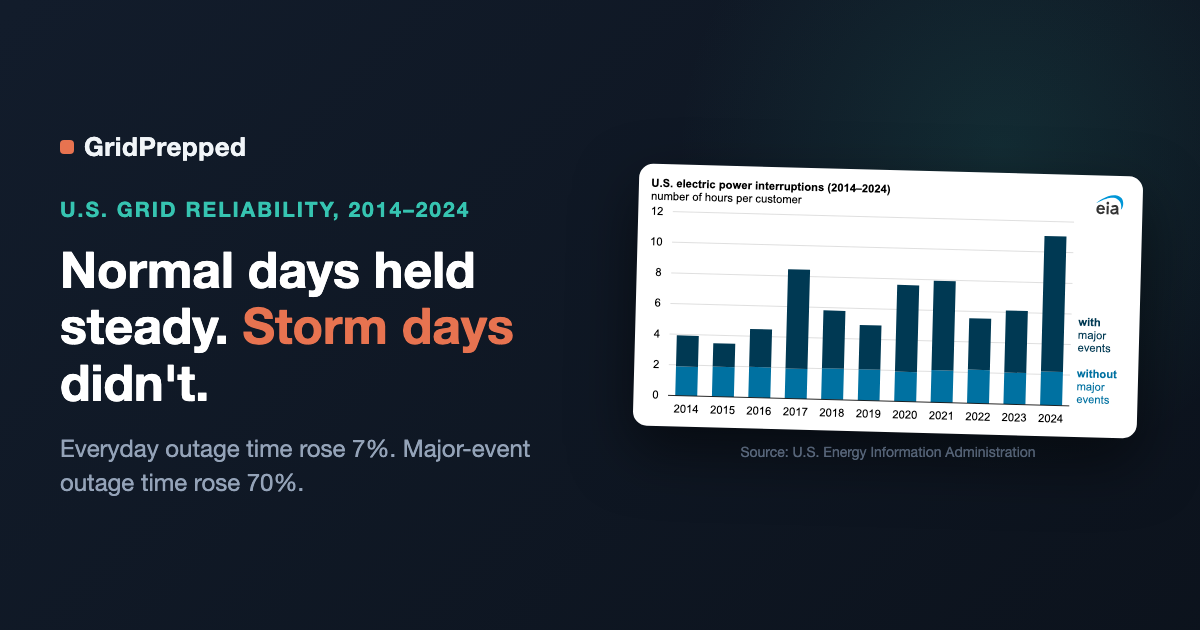
    EIA's 2024 data: the average US customer lost 11 hours to blackouts — almost double the decade norm. Here's what drove it.

    If your power flickered out for a few hours sometime in the last year, you weren't imagining a trend. The U.S. Energy Information Administration's most recent Electric Power Annual puts a number on it: the average American electricity customer went without power for about 11 hours in 2024 — nearly d

    Read Full Post