Is My Power Out, or Just My House?
Two checks settle it in about two minutes: look at your neighbors, then check your panel. What utilities say to do next, who fixes what, and how long a typical outage really lasts.
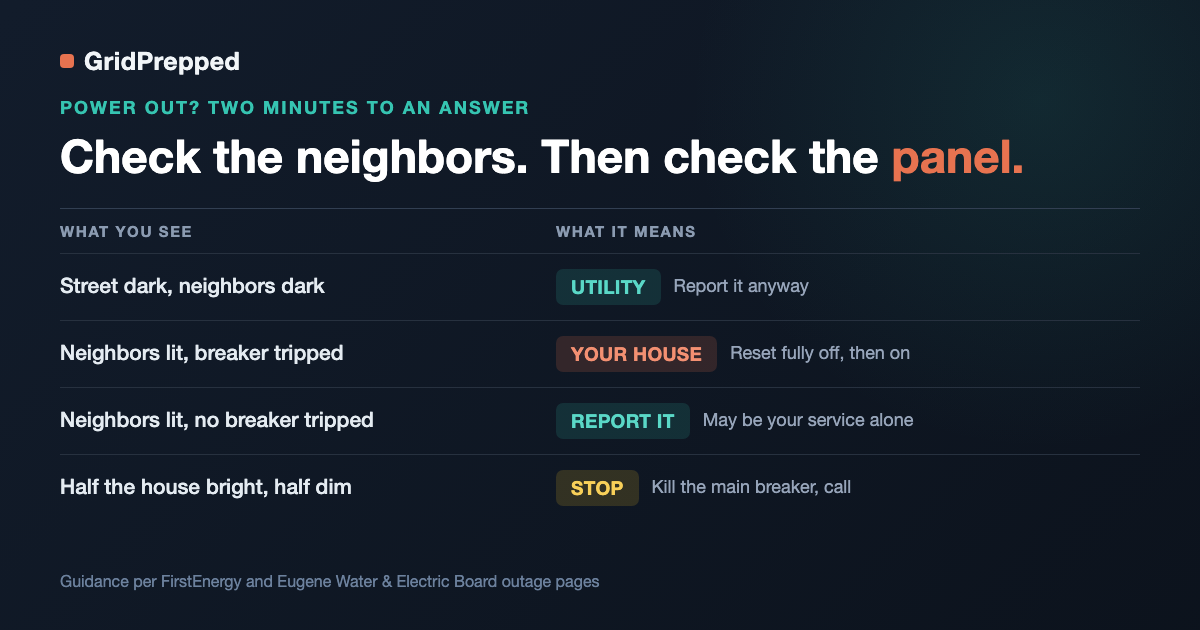
Two checks answer this in about two minutes. Look outside at your neighbors' windows and streetlights, then check your electrical panel for a tripped breaker. If the street is lit and a breaker is flipped, the problem is inside your house. If the street is dark too, it belongs to your utility, and the useful next step is reporting it rather than troubleshooting.
Most people do this backwards, waiting on the assumption that the utility already knows. FirstEnergy, which serves six states, splits its own outage page into "If Only Your Power is Out" and "If Your Neighbor's Power is Out, Too." The two call for different responses.
Start here: the two-minute check
Go in this order.
1. Look at your neighbors. Lit windows across the street, or working streetlights, mean the grid on your block is fine. At night this takes five seconds. In daylight, check a neighbor's porch light or just ask.
2. Check your panel. FirstEnergy describes it as "usually, a gray metal box on an interior wall of your basement or garage, near your outside electric meter." Older homes and apartments often put it somewhere else, like a hallway closet, a utility room, or an exterior wall. Before touching anything, the utility's own first instruction is to "make sure your hands and the floor are dry." Open the door, look for a breaker sitting out of line with the others, and reset it by moving the switch "all the way to 'OFF,' then all the way back to 'ON.'" A half-push does not reset it.
3. If you have fuses instead, replace a blown one with the same ampere rating. FirstEnergy is blunt about the reason: "DO NOT use a new fuse with a higher rating - this could damage your home's wiring or cause a fire!"
4. Stop if anything looks wrong. If you see bare exposed wires, or your service does not use breakers or screw-type fuses, FirstEnergy's guidance is to stop and call the utility instead. If one particular breaker keeps tripping after you reset it, FirstEnergy's guidance is that "there may be a problem on that circuit" and to "have an electrician check it out."
If none of your breakers are tripped and the lights are still off, you have your answer. In FirstEnergy's words, "the problem may be isolated to your individual service." Report it.
One hard safety rule sits above all of this. If you see a downed power line, call 911 immediately, stay at least 30 feet away, and tell anyone nearby to do the same.
What if only part of my house lost power?
This is a different problem, and the one case where the guidance is to stop investigating.
Eugene Water & Electric Board calls it partial power and describes the symptoms precisely: lights that "suddenly get really bright in part of the house and dim in another part," or lights that "work in one part of the home and not another." Check for a tripped breaker first, same as above.
If resetting the breakers does not fix it, EWEB tells its customers to "turn off your main breaker and call us." Your own utility's partial-power guidance may be worded differently, but the escalation is the same shape: stop, kill the main, call them. That is not a typical outage step, and it is worth noticing that the utility asks for it before anyone has diagnosed anything.
A single dead room or a dead run of outlets is usually less dramatic. Look for a GFCI outlet nearby, the kind with test and reset buttons, and press reset. If that does not bring the outlets back, it is an electrician's problem rather than the utility's.
Why are my lights flickering but not going out?
Flickering is not partial power, and EWEB is direct that people confuse the two: "Flickering lights is a complete, momentary power outage, sometimes just for a second or two."
The reason inverts what most people assume. Flickering usually means the grid is doing its job. EWEB explains that flickers "occur when there is a fault in our electrical system, such as a tree or branch contacting a power line. This is actually our system working as it is supposed to. Our system automatically shuts off electricity to isolate the problem, preventing damage which could result in a longer outage and affect many more customers."
So a flicker usually means a protective device operated upstream, not that your wiring is failing. EWEB does note that lights "may also flicker a few times before you lose power entirely," so a run of flickers during a storm is a reasonable cue to charge your phone.
Who fixes what: your side of the meter or theirs?
People assume the utility owns everything up to the meter and the homeowner owns everything past it. It is not that clean. On Central Hudson's own equipment diagram the weather head, the service entrance cable, and the meter pan are all marked as the customer's, and all three sit at or before the meter. The precise line varies by utility and by state, and the exceptions are where people get surprised.
Central Hudson publishes a clear version of this, and its exceptions are instructive. For overhead service it is "responsible for service lines in most cases, except when the home is a considerable distance from the road. In that case, the homeowner may own the poles and electric lines." A long rural driveway can put the poles on your side of the ledger.
Underground service splits three ways, and the split is not intuitive. On a single lot, Central Hudson says homeowners "are responsible for repairs to all underground electric lines." In developments of two to four lots, the company covers the line "up to the point where the lines only provide service to one customer, at which point the homeowner is responsible." In developments of five or more lots, it covers all underground service lines. Same company, same state, three different answers depending on how your subdivision was platted.
Because these boundaries differ between companies, look up your own utility's version before you need it. Central Hudson tells its own customers to call for specifics on their property, which is a reasonable instruction to borrow. One line holds everywhere, and it is the utility's own: "Never tamper with electric meters or service lines. Doing so can result in serious electric shock."
Should I report it if my neighbors already did?
Yes, and this is the most commonly skipped step in the whole process.
Utilities do not automatically know your house is dark. FirstEnergy states it plainly: "We may not know you are without power. Customers should always let us know if they are experiencing an outage, even if a neighbor has already reported it." The reason is that reports help locate the fault. "Our system works best when it receives plenty of information to analyze."
Text and web reporting avoid the hold queue. FirstEnergy customers can text OUT to 544487 or use the online form, and customers with a communication disability can report through the Telecommunications Relay Service at 711. Most utilities offer a text or web equivalent. Finding yours now, while you can see your screen, beats finding it by flashlight.
How long should I expect to wait?
U.S. customers averaged 11 hours without power in 2024, according to the EIA's Electric Power Annual. That number is a hard year rather than a normal one, and EIA's own breakdown says why: major events produced 80% of it. Hurricanes Beryl, Helene, and Milton were the year's biggest contributors. South Carolina customers averaged nearly 53 hours.
Strip out major event days and the picture steadies. EIA's reliability table also publishes the average length of a single interruption, a metric called CAIDI, split by whether major event days are included. Lining up 2022 through 2024 is where it gets interesting. Excluding major events, it was 120.2 minutes in 2022, 121.3 in 2023, and 123.6 in 2024. That is a spread of three and a half minutes across three years. Over the same period, the figure including major events swung from 233.5 minutes to 432.7.
| Year | Typical interruption, no major events | Typical interruption, all events |
|---|---|---|
| 2022 | 120.2 min | 233.5 min |
| 2023 | 121.3 min | 271.8 min |
| 2024 | 123.6 min | 432.7 min |
Source: EIA Electric Power Annual 2024, Table 11.1 (IEEE method), CAIDI columns.
Two practical takeaways. Strip out the major events and a typical interruption runs about two hours, and that has been stable for years. And storms are what break the pattern, not everyday grid behavior. EIA also reports that excluding major events, the average customer sees roughly one interruption per year. That is a national average and not a diagnosis of your outage, but it is a fair reason not to assume the utility is at fault before you have looked outside.
What to do while you wait
Once you know it is the utility's outage, the work shifts to riding it out. Ready.gov's guidance covers the parts people get wrong:
- Keep the fridge and freezer shut. A refrigerator holds food safely about four hours. A full freezer holds temperature about 48 hours. Throw out food that has been at 40°F or higher for two hours or more.
- Unplug or switch off electronics. Power can come back with surges that damage equipment.
- Generators go outside, at least 20 feet from windows, doors, and attached garages. Never use a gas stove or oven to heat your home.
- Install carbon monoxide detectors with battery backup on every level of your home.
- Have a flashlight for each person, not one shared candle.
Know before the lights go out
The diagnosis above is easier when you already know a storm is heading for your area, because it settles the neighbors-versus-breaker question before you open the panel. A tripped breaker during a calm evening and a dark street during a wind advisory are two different situations.
GridPrepped's alerts page answers that part for free and without an account. Enter a ZIP code and it shows what is active there now, pulling live from the National Weather Service, USGS, AirNow, and NIFC. If a wind or ice event is already flagged for your area, you have context before you open the panel.
A free account turns that lookup into email alerts across up to five locations, each with its own label and severity threshold, set to off, severe only, or moderate and up. You can watch your own address at moderate and a college kid's campus at severe only, then get one digest covering both. The readiness score also works without an account.
Neither replaces the two-minute check. Neighbors, then panel. That order has not changed.
Sources
- U.S. Energy Information Administration, Electric Power Annual 2024, Table 11.1, Reliability Metrics of U.S. Distribution System: https://www.eia.gov/electricity/annual/html/epa_11_01.html
- U.S. Energy Information Administration, Today in Energy, December 1, 2025: https://www.eia.gov/todayinenergy/detail.php?id=66744
- FirstEnergy, If You Lose Power: https://www.firstenergycorp.com/outages_help/outage_help/what_to_do_if_youlosepower.html
- FirstEnergy, Checking Circuit Breakers or Fuses (page last modified February 24, 2015): https://www.firstenergycorp.com/help/outages/what_to_do_if_youlosepower/checking_circuitbreakersorfuses.html
- Eugene Water & Electric Board, Partial Power and Flickering Lights: https://www.eweb.org/outages-and-safety/power-outages/partial-power-and-flickering-lights
- Central Hudson, Electric Service Equipment: Who is Responsible: https://www.cenhud.com/en/outages/prevention--repair-strategies/electric-equipment-who-is-responsible/
- Ready.gov, Power Outages: https://www.ready.gov/power-outages
Build your household's emergency plan
Free, and built around where you live.