CPAP Backup Power: What You Actually Need
How big a battery your CPAP needs in a power outage, why the humidifier changes everything, and how to connect a power station, car or generator.
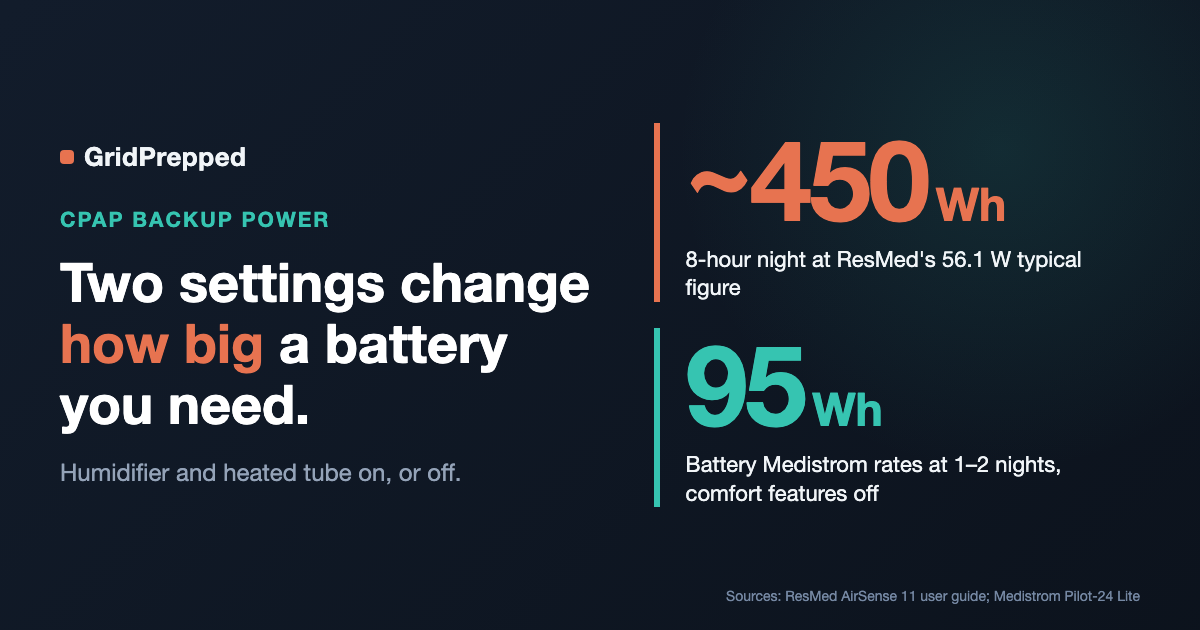
A CPAP needs a battery sized for a full night of your actual settings, a way to connect it that your machine's maker supports, and a plan for who swaps it over when the power drops. For a ResMed AirSense 11, ResMed lists typical power use of 56.1 watts, which works out to roughly 450 watt-hours for an eight-hour night. Turn off the humidifier and heated tube and the need can drop sharply. Medistrom says its 95 watt-hour CPAP battery runs one to two nights at an average pressure setting with both disabled.
That gap, between about 450 and under 100 watt-hours a night, is the most useful number in this whole subject. It decides whether you need a small travel battery or a power station the size of a cooler.
One caution before the details. This article covers equipment and power. Your therapy is your doctor's call, so check with your doctor or sleep provider before changing settings or going without the machine, and with the device maker before connecting it to any battery, inverter or generator. The FDA's advice on the equipment side is the same: read your user instructions or call your distributor or device manufacturer to find out whether your device can be used with batteries or a generator.
How much power does a CPAP use?
Less than most people expect, as long as the comfort features are off.
ResMed's AirSense 11 user guide lists a 65-watt power supply that outputs 24 volts, with typical power consumption of 56.1 watts and peak consumption of 73.2 watts. ResMed doesn't say what settings that typical figure assumes, but a power-supply rating like this is measured at the wall, and the machine's biggest loads are the heated humidifier and heated tube. Treat 56.1 watts as a planning number for a night with comfort features on.
The humidifier and heated tubing are heaters, and heaters are what eat batteries. The blower that actually moves air draws far less. That is why battery makers such as Medistrom quote runtime with the humidifier and heated tubing disabled, and why the same battery can last a fraction of a night or more than one, depending on those two settings.
Other brands and older machines use different power supplies and voltages. The wattage printed on the brick is its output rating, which is different from what the machine typically draws. The specifications page in your manual is the better source, and if it lists a typical figure, plan around that plus generous headroom.
How big a battery do I need for my CPAP?
Battery capacity is sold in watt-hours (Wh). To estimate, multiply your machine's draw in watts by the hours you sleep.
Using ResMed's 56.1-watt typical figure for the AirSense 11:
| Battery capacity | Hours at 56.1 W (before losses) | Roughly covers |
|---|---|---|
| 95 Wh | 1.7 | Part of one night with comfort features on |
| 256 Wh | 4.6 | Half a night |
| 500 Wh | 8.9 | One night, with little or no margin |
| 1,000 Wh | 17.8 | Nearly two nights |
| 2,000 Wh | 35.7 | Three to four nights |
Those hours are the ceiling. Real runtime comes in lower, because no battery delivers its full rated capacity and converting battery power back to wall power wastes some along the way. Leave real headroom, and test it at home on a normal night before you rely on it.
How many nights to plan for depends on where you live. The U.S. Energy Information Administration's reliability data shows the average customer went without power for about 11 hours in total across 2024, nearly twice the prior decade's average, and about 80% of that came from major events like hurricanes. Most outages are shorter than a night, but one storm can last days. A one-night battery covers the short ones. A multi-night plan needs either a bigger battery, a way to recharge it, or somewhere to go.
Does turning off the humidifier make a difference?
Yes. For battery sizing it is the biggest factor, though whether it's right for you is your sleep provider's call.
Compare the two manufacturer statements side by side. ResMed's typical figure for the AirSense 11 implies about 450 Wh for an eight-hour night. Medistrom says its 95 Wh Pilot-24 Lite gives one to two nights of continuous runtime at an average pressure setting with the humidifier and heated tubing disabled. Those two numbers aren't a clean lab comparison. Medistrom's claim covers many machines at an average pressure, and ResMed's is measured at the wall. But the direction is clear: with humidification and the heated tube off, a CPAP can need a fraction of the power, roughly five to ten times less on these two makers' figures.
Your pressure setting matters too. Higher pressure means the blower works harder. If your prescribed pressure is high, expect runtimes at the short end of any maker's range.
Whether running without humidification is comfortable for you is a question for your sleep provider. Some people find a dry night tolerable. Others do not. Ask before the outage, not during it.
Can I run a CPAP on a portable power station, a car or a generator?
Often, if your machine's maker supports the connection. Here are the three common routes.
Portable power station or CPAP battery. These connect one of two ways. Plugging the normal power brick into the station's AC outlet is simple but wastes some energy, since the battery's DC power is converted to AC and then back to DC by the brick. A DC cable avoids that double conversion. For the AirSense 11, the user guide lists an Air11 DC/DC converter among the accessories available through your care provider. Stick to the cable your machine's maker supports.
ResMed also points out a practical catch in its own guidance on CPAP batteries: in a power outage the machine simply shuts off, and since it can plug into either the wall or a battery but not both, someone has to move the plug. Some dedicated CPAP batteries are designed to sit inline as a permanent backup so the switch happens on its own. Medistrom markets the Pilot-24 Lite that way. Check which cable your machine needs; on the product page we checked, the AirSense 11 cable was sold separately.
Car. With the maker's DC converter, a car's 12-volt outlet can power many CPAPs. Check your converter's input rating first, and watch the car's own battery, since an overnight draw from a parked car can leave it unable to start. Never sleep in a running car in a garage or any enclosed space. The FDA's guidance on medical devices in disasters specifically warns against running a generator or any gasoline-powered engine inside a garage, even with the doors or windows open, because of carbon monoxide.
Generator. The FDA tells device users to ask the manufacturer whether the device can be used with a generator, and to locate one if possible. A generator always runs outdoors and away from windows, doors and vents. If you share a generator with the fridge and furnace, keep the CPAP on a circuit you leave alone all night.
Will my CPAP turn back on when the power comes back?
The AirSense 11 will. Its user guide says that if power is interrupted during therapy, the device automatically restarts therapy when power is restored.
Not every device does that, and the FDA adds a second check that applies to all of them: when power returns, confirm your settings have not changed, because many medical devices reset to a default mode after an interruption. Glance at the screen the next morning after any outage, even a short one.
Does insurance pay for a CPAP battery?
Often not. In ResMed's own Q&A on whether to buy a CPAP battery, its expert says most insurance companies will not cover a battery for CPAP machines because they consider it a convenience. Policies differ, so call yours, but budget for it as an out-of-pocket purchase.
Should I tell my utility I use a CPAP?
It is worth asking. The FDA recommends notifying your electric company and fire department that you have a medical device that needs power.
Many utilities run medical or life-support registration programs, and eligibility varies. PG&E's program sheet, for example, says it attempts to notify life-support customers before planned work and rolling blackouts. It also says it cannot give advance notice of unscheduled outages from storms or equipment failure, and that it cannot guarantee outages will not occur. Its eligibility rules are strict. A medical practitioner has to certify the need, the sheet says equipment used for therapy generally does not qualify, and CPAP isn't on its list of life-support examples. Rules differ by utility, so ask yours directly, and don't count on registration.
Registration is a notice service, not a power source. It can buy you warning time. You still need the battery.
Knowing when the outage is coming
Most bad outages come with a weather forecast attached. In 2024, according to EIA, Hurricane Helene left 5.9 million customers without power across 10 states. Storms like that show up in forecasts days ahead, and in National Weather Service watches and warnings a day or two out. That is the window to charge every battery in the house.
That is the job of GridPrepped's free alerts page. Enter a ZIP code and it shows active National Weather Service warnings, watches and advisories for it, no account required. With a free account you can get them by email for up to five locations, with severity set separately for each. That matters for CPAP users in a specific way: if your mother runs a CPAP two states away, you can watch her ZIP at "Severe only" alongside your own at "Moderate & up," and one digest email covers both. A warning for her county the day before is the cue to call and ask whether her battery is charged.
Write the setup down
Picture a 2 a.m. outage. The machine stops, you wake up groggy, and the battery is in a closet with a cable you have used once. Or you are away and your partner is the one fumbling for it.
The saved emergency plans in your GridPrepped dashboard (free account) include a Medical Reference section with a field labeled "Medical Devices & Power Needs." Write down where the battery lives, which cable connects it, how long it lasted on your test night, and whether the humidifier should be off. The section also carries an "Ensure medical devices have backup power" item on its checklist. A plan anyone in the house can read could make that 2 a.m. swap a lot calmer.
A CPAP outage checklist
| Do this | When |
|---|---|
| Find your machine's wattage on the power brick or manual | Once |
| Ask your sleep provider whether humidifier-off nights are OK for you | Once |
| Ask the maker which battery, DC cable or inverter it supports | Before buying |
| Buy a battery sized for at least one full night of your real settings | Before buying |
| Test it overnight at home and note the hours | After buying |
| Ask your utility about medical registration | Once |
| Write the setup into your household plan | After testing |
| Recharge the battery and set aside distilled water if you use a humidifier | When a storm warning hits |
| Check your settings after power returns | After any outage |
If you have not built a household plan yet, start one free at gridprepped.com/plan. It takes a few minutes with no account needed, and you can flag medical needs as you go. Save it with a free account to get the Medical Reference section where the CPAP details live.
Sources
- ResMed, AirSense 11 User Guide (Americas), technical specifications and power-interruption note: https://document.resmed.com/documents/products/machine/airsense-11/user-guide/airsense11_user-guide_amer_mul.pdf
- ResMed, "Should I get a CPAP battery?": https://www.resmed.com/en-us/sleep-health/blog/should-i-get-a-cpap-battery/
- Medistrom, Pilot-24 Lite product page: https://www.medistrom.com/products-pilot24-lite.html
- U.S. Food and Drug Administration, "FDA Offers Tips about Medical Devices and Natural Disasters": https://www.fda.gov/medical-devices/emergency-situations-medical-devices/fda-offers-tips-about-medical-devices-and-natural-disasters
- PG&E, Medical Baseline General Program Information: https://www.pge.com/assets/pge/docs/account/customer-service/medical-baseline-program-info-lp.pdf
- U.S. Energy Information Administration, "Hurricanes in 2024 led to the most hours without power in the United States in 10 years": https://www.eia.gov/todayinenergy/detail.php?id=66744
Build your household's emergency plan
Free, and built around where you live.