Generator vs. Battery Backup: Which Is Right for Your Home?
Generator vs. battery backup: outage length, cost, noise, and safety compared so you can pick the right backup power for your home.
<!-- query: generator vs battery backup which is right for your home -->
# Generator vs. Battery Backup: Which Is Right for Your Home?
For most homes, a generator is the better fit if you need whole-house power for multi-day outages and can install a fuel line or store fuel safely. A battery backup is the better fit if you want quiet, no-fuel power for a handful of essential circuits and shorter outages. The real decision comes down to how long your outages actually run, how much you're willing to spend, and how much noise and maintenance you're willing to live with.
What's actually different between a generator and a battery backup?
A generator makes electricity on demand by burning fuel, gasoline, propane, or natural gas, in a small engine connected to an alternator. As long as fuel keeps coming, it keeps making power. That's true whether it's a $500 portable unit from the hardware store or a $20,000 whole-home standby system wired into your electrical panel.
A battery backup stores electricity that was already made somewhere else, either pulled from the grid before an outage or from solar panels, and releases it through an inverter. It has a fixed amount of energy, measured in kilowatt-hours (kWh), and once that's used up, it's done until it's recharged. No fuel, no exhaust, no combustion.
That single difference, fuel versus stored charge, explains almost everything else about how the two options behave.
How long will each one actually power your home?
Portable gasoline generators typically run 6 to 14 hours on a full tank depending on load and tank size, according to generator manufacturer runtime guides. That means multi-day outages require keeping extra fuel on hand and refueling by hand, often at 3 a.m. in the rain. Standby generators tied to a natural gas or propane line don't have that problem. As long as the gas keeps flowing, they can run for the full length of an outage, which is the main reason they're the default choice for homes that lose power for days at a time.
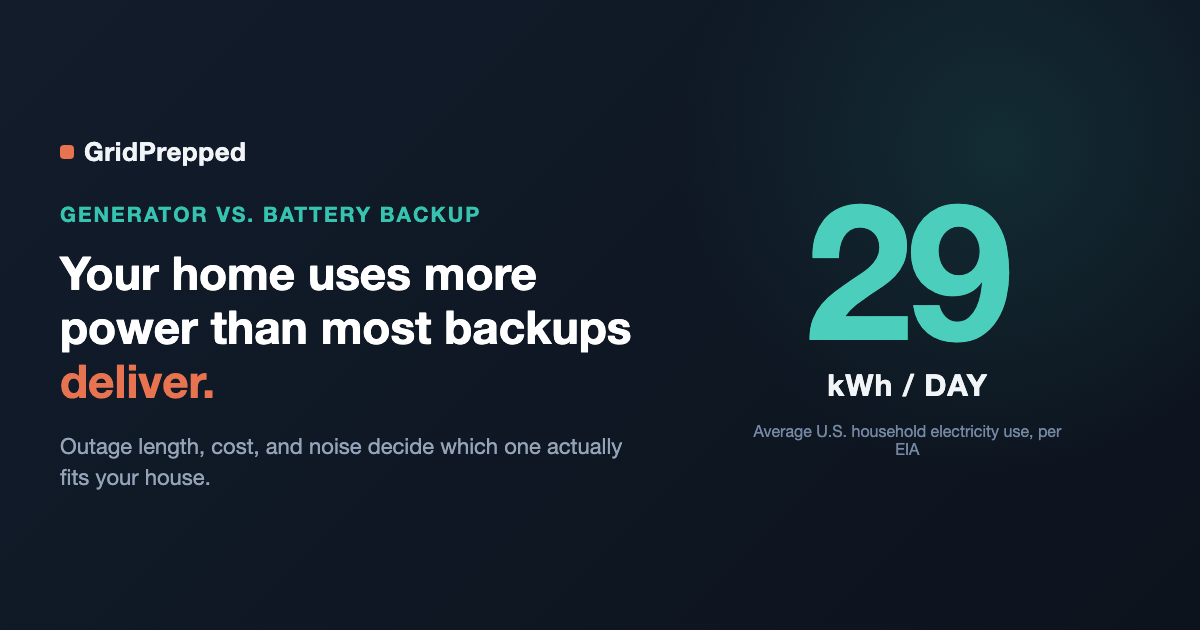
Battery backups are capped by their capacity. The average U.S. household uses roughly 865 kWh a month, about 29 kWh a day, according to the U.S. Energy Information Administration. A single Tesla Powerwall 3 stores 13.5 kWh, per Tesla's own spec sheet, enough to cover essentials like a refrigerator, some lighting, and phone charging for several hours to around a day, but not a whole house running normally. Portable power stations in the same price tier, like EcoFlow's Delta Pro 3, top out around 4 kWh per unit before you start stacking expansion batteries. Batteries recharge from a wall outlet or solar panels, but during a grid outage without solar, that recharge has to come from somewhere, which is the tradeoff nobody puts on the box.
What does each option cost, installed?
| Option | Typical cost | Installation |
|---|---|---|
| Portable gasoline generator | A few hundred to roughly $2,000 | None, plug in manually |
| Whole-home standby generator | Roughly $3,000 to $25,000 depending on size and electrical work, per industry cost guides (HomeGuide, Angi, ProjectCostPro) | Professional, permits and a transfer switch required |
| Portable power station | Roughly $1,000 to $4,000+ for 2 to 4 kWh | None, plug-and-play |
| Home battery system | Roughly $800 to $1,650 per kWh installed, per solar-industry cost data; a single 13.5 kWh Tesla Powerwall 3 runs about $15,300 to $16,200 | Professional, panel and often solar integration |
Portable options win on upfront cost and flexibility. Whole-home installs, gas or battery, win on hands-off reliability but require a real budget and, for generators, ongoing fuel and maintenance costs the sticker price doesn't show.
Generator vs. battery backup, at a glance
| Generator | Battery backup | |
|---|---|---|
| Runs on | Gasoline, propane, or natural gas | Stored charge, recharged from grid or solar |
| Max runtime | Days, if fuel supply holds | Hours to about a day per charge |
| Noise | 58 to 73 dBA for portables, quieter for enclosed standby units | Silent |
| Carbon monoxide risk | Yes, must run outdoors only | None, no combustion |
| Indoor use | Never | Yes |
| Best for | Multi-day outages, whole-home power | Short outages, quiet essentials, homes without a fuel line |
Is a battery backup safer than a generator?
They carry different risks, not a simple "safer" and "less safe." Portable generators produce carbon monoxide, an odorless gas, in quantities the Consumer Product Safety Commission compares to hundreds of cars running at once. More than 100 people die every year in the U.S. from CO poisoning linked to portable generators, per CPSC's Carbon Monoxide Information Center, almost always because a unit was run indoors, in a garage, or too close to windows and doors. Running a generator at least 20 feet from the house, with the exhaust pointed away, and installing CO alarms on every level, eliminates most of that risk.
Batteries don't produce carbon monoxide because there's no combustion, but lithium battery systems carry their own failure mode: thermal runaway, which can lead to a fire. It's rare in properly built consumer units, and the industry standard to look for is UL 9540 certification, which tests the whole system, battery, inverter, and enclosure, together rather than just the cells. A certified system from a major manufacturer is a reasonable baseline for either a home battery or a large portable power station.
Which one should you actually buy?
A few questions narrow it down fast:
How long do your outages usually run? If you're consistently down for multiple days, a generator with a fuel line is hard to beat. If outages in your area are typically a few hours, a battery covers it without the noise or fuel storage.
Do you have a natural gas or propane line, and can you store fuel safely? No gas line and no safe fuel storage pushes you toward a battery by default.
Does your budget fit an installed system, or are you working with a portable option? Portable versions of both exist at a fraction of the installed cost, with the tradeoff of lower capacity and manual setup.
Do you need it silent or usable indoors? Apartments, townhomes, and anyone with close neighbors are effectively limited to battery options, since generators can't run indoors or too close to a structure.
Before spending $10,000 or more on a standby generator, it's worth confirming what your home actually needs rather than guessing at a size. GridPrepped's readiness score (`/score`) walks through your home's specific outage risks and current setup in a few minutes, which is a cheaper way to find out you need a 10 kW unit, not a 22 kW one, than finding out from an oversized invoice.
Can you run a generator and a battery backup together?
Yes, and plenty of households do. A common setup pairs a whole-home generator for multi-day outages with a smaller battery or uninterruptible power supply (UPS) for electronics that can't tolerate the gap between the power going out and the generator starting up, typically 10 to 30 seconds for an automatic transfer switch. That gap is long enough to reboot a modem, a desktop computer, or certain medical equipment. A battery smooths that transition; the generator carries the load for as long as the outage lasts.
Utilities that run Public Safety Power Shutoffs, like PG&E in California, typically give customers 24 to 48 hours of advance notice before cutting power in high fire-risk conditions. That lead time is exactly when a battery should be topped off and a generator's tank filled, not after the lights go out. GridPrepped's alerts (`/alerts`) can watch up to 5 locations with per-location severity settings, so a heads-up on an incoming PSPS or storm warning reaches you with enough time to actually prep the equipment instead of scrambling once it's already dark.
Bottom line
Neither option is universally better. A generator is fuel-dependent, noisy, and needs distance from the house, but it can run for as long as fuel lasts. A battery is quiet, safe indoors, and needs no fuel, but it's capped by its capacity and needs a recharge source. Match the choice to your actual outage pattern, your home's fuel access, and your budget, and build a plan around whichever one you pick with GridPrepped's `/plan` so the rest of your household knows what's covered and what isn't before the power goes out.
Sources
- U.S. Energy Information Administration, residential electricity consumption: https://www.eia.gov/todayinenergy/detail.php?id=65244
- Tesla Powerwall specifications: https://www.tesla.com/powerwall
- Consumer Product Safety Commission, Carbon Monoxide Information Center: https://www.cpsc.gov/Safety-Education/Safety-Education-Centers/Carbon-Monoxide-Information-Center
- UL 9540 energy storage system certification overview: https://eticaag.com/what-is-ul-9540-for-battery-energy-storage-systems/
- EcoFlow Delta Pro 3 product specifications: https://us.ecoflow.com/products/delta-pro-3-portable-power-station
- Whole-home generator installed cost guides: https://homeguide.com/costs/generator-cost, https://www.angi.com/articles/how-much-does-it-cost-install-generator.htm, https://projectcostpro.com/calculators/generator/
- Home battery storage installed cost data: https://www.ohmsnap.com/battery-storage-cost-2026, https://www.solarreviews.com/blog/is-the-tesla-powerwall-the-best-solar-battery-available
Build your household's emergency plan
Free, and built around where you live.