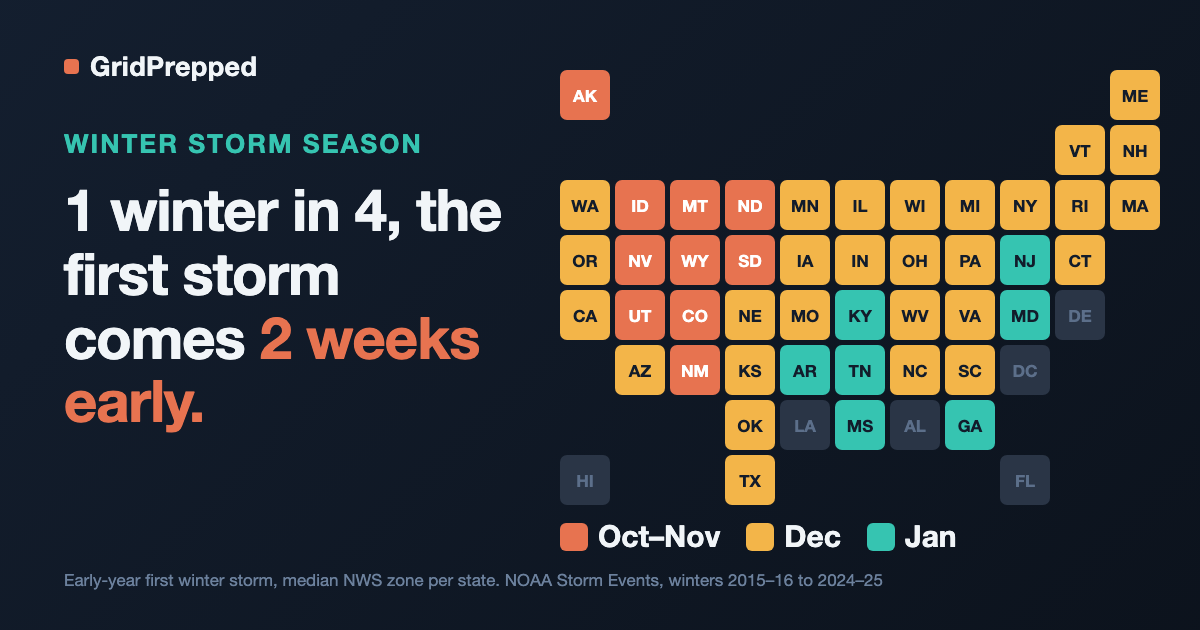
When Does Winter Storm Season Start Where You Live? Plan for the Early Year
Ten winters of NOAA data: 1 year in 4, the first winter storm arrives about two weeks early. Find your state's early-year date and set a deadline.
It's natural to plan winter prep around the date winter usually shows up. The problem is that "usually" is an average, and averages hide the early years.
We pulled ten winters of NOAA's Storm Events Database, July 2015 through June 2025, and looked for the first winter-storm-level event of each season: anything logged as a Winter Storm, Blizzard, Ice Storm, or Heavy Snow. We did that separately for every NWS forecast zone, then kept the 2,436 zones that got at least one of those events in 5 or more of the 10 winters.
The finding that matters for planning: in about one winter out of four, the first storm arrives two weeks or more ahead of a typical year. The median gap across those zones was 15 days. And 554 of the 2,436 zones (23%) had at least one winter in the last ten where the first storm came before November 1.
So if you plan for the typical date, the first storm beats you in close to half the winters that have one, and in about one in four it beats you by two weeks or more.
The early-year date for your state
For each zone we took two dates: the typical first storm (the median across winters that had one) and the early-year date (the 25th percentile, so roughly 1 winter in 4 comes this early or earlier). Each column shows the middle value across that state's regular-winter zones. States with fewer than five regular-winter zones are left out.
| State | Early year (1 in 4) | Typical year |
|---|---|---|
| Montana | Oct 27 | Nov 20 |
| North Dakota | Nov 6 | Dec 4 |
| New Mexico | Nov 11 | Dec 4 |
| Colorado | Nov 15 | Dec 13 |
| Wyoming | Nov 16 | Dec 6 |
| Idaho | Nov 20 | Dec 12 |
| Alaska | Nov 21 | Dec 11 |
| South Dakota | Nov 23 | Dec 9 |
| Nevada | Nov 25 | Dec 24 |
| Utah | Nov 27 | Dec 4 |
| Minnesota | Dec 1 | Dec 15 |
| Vermont | Dec 3 | Dec 16 |
| Texas | Dec 4 | Jan 7 |
| Maine | Dec 6 | Dec 18 |
| New Hampshire | Dec 6 | Dec 18 |
| California | Dec 8 | Dec 29 |
| Michigan | Dec 12 | Jan 3 |
| Washington | Dec 12 | Dec 30 |
| Kansas | Dec 13 | Jan 6 |
| Oregon | Dec 15 | Dec 24 |
| New York | Dec 15 | Jan 6 |
| South Carolina | Dec 15 | Jan 11 |
| Oklahoma | Dec 16 | Jan 9 |
| Pennsylvania | Dec 16 | Jan 9 |
| Wisconsin | Dec 16 | Jan 6 |
| Massachusetts | Dec 16 | Jan 7 |
| Nebraska | Dec 18 | Jan 2 |
| Iowa | Dec 23 | Jan 11 |
| Indiana | Dec 26 | Jan 19 |
| Virginia | Dec 27 | Jan 6 |
| Arizona | Dec 28 | Jan 7 |
| West Virginia | Dec 28 | Jan 6 |
| Ohio | Dec 29 | Jan 16 |
| Missouri | Dec 29 | Jan 7 |
| Illinois | Dec 29 | Jan 8 |
| Rhode Island | Dec 30 | Jan 7 |
| Connecticut | Dec 30 | Jan 7 |
| North Carolina | Dec 30 | Jan 13 |
| New Jersey | Jan 3 | Jan 13 |
| Maryland | Jan 4 | Jan 7 |
| Kentucky | Jan 5 | Jan 12 |
| Georgia | Jan 6 | Jan 15 |
| Tennessee | Jan 10 | Jan 14 |
| Mississippi | Jan 13 | Jan 15 |
| Arkansas | Jan 14 | Jan 21 |
These are middle values, so the mountain zones in your state run earlier and the valleys and coasts run later. In states like Texas, the row covers only the zones where winter storms are regular, mostly the Panhandle and north. And "winter storm" is judged by each local NWS office against its own criteria, which is the right yardstick here: it marks the first storm that is a big deal for that place, whether that means a foot of mountain snow in Montana or a glaze of ice in Arkansas.
What an early year looks like
On October 26, 2020, freezing rain started falling across central and western Oklahoma and kept going into the evening of the 28th. The NWS entry in the Storm Events Database describes ice accumulations of at least 1.5 inches in west-central Oklahoma and more than half an inch from Ponca City to Oklahoma City to Lawton, and says "hundreds of thousands of people were without power by the 28th" (NOAA Storm Events Database, event 924702, Oklahoma County).
Oklahoma's typical first winter storm, by our count, lands around January 9. That storm came about ten weeks early. It also covered a lot of ground: it was the first winter storm of the season in 31 of Oklahoma's 49 regular-winter zones, all of them before November 1.
The storms that catch people unready are the ones that come before the calendar says they should.
Set your deadline, then work backward
Find your state in the table, take the early-year date, and back it off two weeks. That is your winter-ready deadline. For Colorado that lands around November 1. For Pennsylvania it is around December 2. For Montana, it is the middle of October.
A lot of winter supplies quietly go bad between seasons: the batteries in the flashlight drawer, the hand warmers from two winters ago, the water you stored last spring, a backup supply of a medication. The GridPrepped supply tracker lets you record an expiration date on each item, then flags anything expiring within 30 days and anything already expired. Picture your early-year date arriving in mid-November and the only working batteries in the house being the ones in the TV remote. Logging those dates now is one way to make sure the problem shows up on a screen instead of during an ice storm.
The storm that matters may not be at your house
The early-year problem gets bigger when your household lives in more than one place. Say your daughter is a freshman in Bozeman and you live in Iowa. In the Gallatin County forecast zone around Bozeman, the first winter storm typically showed up around October 28, and in an early year by mid-October. Iowa's early-year date is December 23. Her first winter storm may arrive two months before yours, in a town she has never lived through a winter in.
GridPrepped alerts can watch up to five locations, each with its own label and its own severity setting: off, "Severe only," or "Moderate & up." You could run your own ZIP at Moderate & up and her campus at Severe only, so her campus alerts are saved for the bigger warnings instead of every advisory. Each alert email covers all your watched locations, grouped by location. It could help you text her the night before instead of the morning after.
A short pre-winter checklist
1. Look up your early-year date above and subtract two weeks.
2. Check expiration dates on batteries, stored water, food, and any backup medications, and log them.
3. Test the things that sat unused all summer: flashlights, a generator if you have one, the car's ice scraper and blanket.
4. Add every location your family will be this winter to your alerts, with a severity that fits each one.
None of this guarantees a smooth winter. It does make it more likely the first storm finds you ready in the years it shows up early, which, according to ten years of NOAA data, is about one year in four.
Start your winter supply list in the GridPrepped supply tracker (sign-in required).
Sources and method
NOAA NCEI Storm Events Database, bulk details files for 2015 through 2025: https://www.ncei.noaa.gov/pub/data/swdi/stormevents/csvfiles/
Window: winter seasons July 1, 2015 through June 30, 2025 (10 seasons). Event types counted: Winter Storm, Blizzard, Ice Storm, Heavy Snow. Advisory-level "Winter Weather" events are not counted. 711,827 records scanned across the 2015-2025 annual files (651,505 inside the July 2015 to June 2025 window), 56,980 winter-storm-level records in window. Six July and August records outside Alaska were excluded: four July 2018 Texas entries coded as Blizzard whose narratives describe drought (coding errors), and two real August 28, 2024 snowfalls in Glacier National Park, left out as off-season outliers. A zone counts as regular-winter if it had at least one qualifying event in 5 or more of the 10 seasons (2,436 of 3,895 zone codes with any event; NWS renumbered some zones during the decade, so a few places appear under two codes, and a small number of records are logged by county rather than zone). Typical date is the median of each zone's first-event dates across seasons with an event; early-year date is the 25th percentile. State values are the median of each column across that state's regular-winter zones.
Oklahoma October 2020 ice storm: NOAA Storm Events Database event 924702 (Oklahoma County, Ice Storm, Oct 26-28, 2020), episode narrative, 2020 details file at https://www.ncei.noaa.gov/pub/data/swdi/stormevents/csvfiles/
Build your household's emergency plan
Free, and built around where you live.