Is the U.S. Power Grid Getting Less Reliable? What the Data Shows
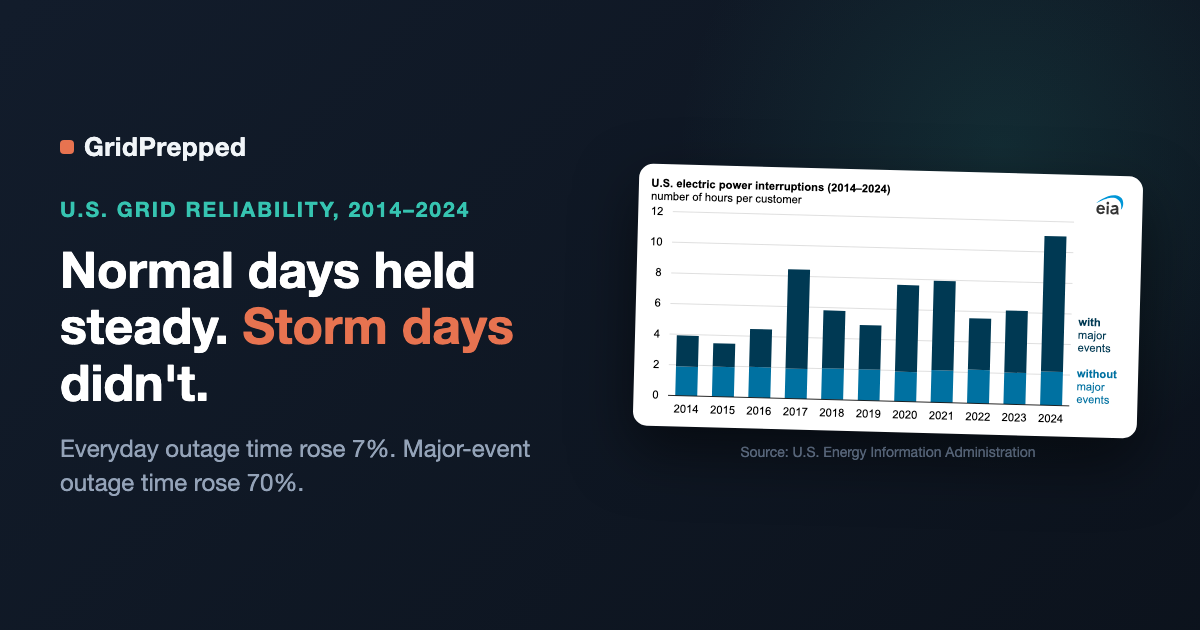
EIA data, 2014-2024: everyday outage time barely moved, but storm-driven outage time rose 70%. What that means for how you prepare.
The short answer is yes and no, and the split between the two matters more than the headline. On an ordinary day, the American grid is about as reliable as it was ten years ago. The extra hours people lose now come almost entirely from big weather events, and those have grown a lot.
That comes from the federal government's own reliability numbers. Every year, utilities report to the U.S. Energy Information Administration how many minutes the average customer went without power. They split it two ways: interruptions on normal days, and interruptions on "major event days," the storm days that blow past a utility's usual range. EIA publishes both columns back to 2014. We lined them up.
The everyday grid: barely moved
Here is how much power the average customer lost on normal days, using EIA's figures for utilities that follow the IEEE reporting standard.
| Year | Normal-day outage time | Major-event outage time | Total |
|---|---|---|---|
| 2014 | 1 hr 54 min | 2 hr 2 min | 3 hr 56 min |
| 2016 | 2 hr 0 min | 2 hr 29 min | 4 hr 28 min |
| 2018 | 2 hr 1 min | 3 hr 48 min | 5 hr 49 min |
| 2020 | 1 hr 56 min | 5 hr 40 min | 7 hr 36 min |
| 2022 | 2 hr 11 min | 3 hr 22 min | 5 hr 33 min |
| 2024 | 2 hr 12 min | 8 hr 51 min | 11 hr 3 min |
Normal-day outage time has stayed between 114 and 132 minutes a year for the entire eleven-year record. It did drift up a little. Comparing the five-year average for 2014-2018 against 2020-2024, it rose from 118 minutes to 126, about 7%. The number of normal-day outages barely changed: 1.04 per customer in 2014, 1.07 in 2024. That's roughly one ordinary blip a year, lasting about two hours, then and now.
So if your sense of the grid comes from the occasional summer evening with the lights out for an hour, your instinct is right. That part hasn't gotten meaningfully worse.
The storm column: up 70%
The other column tells a different story. Major-event outage time averaged 196 minutes a year from 2014 to 2018. From 2020 to 2024 it averaged 333 minutes, an increase of 70%.
The worst years cluster at the recent end, too. Ranking all eleven years by major-event minutes, four of the five worst fall in 2020-2024: 2024 (531 minutes), 2021 (350), 2020 (340) and 2023 (243). The only older year in the top five is 2017, the year of Harvey, Irma and Maria.
EIA's own write-up on 2024 puts names to the spike. In July, Hurricane Beryl left 2.6 million Texas customers without power. In September, Hurricane Helene left 5.9 million customers dark across 10 states. In October, Hurricane Milton cut power to 3.4 million in Florida. EIA counted major events as 80% of all the time Americans spent without electricity that year.
Two honest caveats. The utilities in the IEEE group change a little from year to year, and the "major event day" cutoff is set from each utility's own recent history, so it shifts over time. Neither changes the basic picture: the normal-day line is flat-ish, and the storm line is where the movement is.
What that means for how you prepare
If outages were getting more frequent across the board, the right response would be a bigger everyday cushion: a few more flashlights, a power bank by the bed. The data points somewhere else. The short outage you already handle well is not the one that's growing. The one that's growing is the multi-day event, where the question shifts from "where's the flashlight" to "how much water do we have, and is it still good."
That's a supply question, and supplies are easy to buy once and forget. Water jugs, batteries, canned food and spare medication all have dates. The closet that was fully stocked in 2022 can be half-expired by the time a Beryl-sized storm reaches your street. GridPrepped's supply tracker keeps expiration dates on what you've stored and shows what is expired or coming due, so the multi-day kit is current when you open it, not when you last remembered it.
Helene raises a second problem. Its 5.9 million outages were spread across 10 states, and plenty of families had someone in more than one of them: a parent in Asheville, a kid at school in South Carolina, a home in Florida. A storm that size doesn't stay in your zip code. GridPrepped alerts let you watch up to five locations and set the severity for each one separately, so your own address can be on "moderate and up" while a parent's town is on "severe only." Everything arrives in one email, grouped by location, rather than a pile of separate warnings.
The third piece is the decision you don't want to make in the dark. A two-hour outage needs no plan. A four-day one raises real questions. Who checks on the neighbor with the oxygen concentrator? When do you leave for a relative's house? Where do you meet if cell service is spotty? A saved emergency plan puts those answers somewhere the whole household can find them, worked out on a calm afternoon instead of on day two.
A practical takeaway
The everyday grid is holding steady, which is good news. The long, weather-driven outage is the one getting bigger, so it's the one worth preparing for. Sizing your prep for three to four days instead of three to four hours could make a real difference the next time a named storm comes through.
If you want a starting point, open your supply tracker, add the water and batteries you already have with their dates, and compare that against four days for everyone in the house. Whatever is missing becomes a short shopping list.
Sources
- U.S. Energy Information Administration, Electric Power Annual 2024, Table 11.1, Reliability Metrics of U.S. Distribution System (IEEE method, 2014-2024; major-event minutes computed as "All Events" SAIDI minus "Without Major Event Days" SAIDI): https://www.eia.gov/electricity/annual/html/epa_11_01.html
- U.S. Energy Information Administration, Today in Energy, "Hurricanes in 2024 led to the most hours without power in the United States in 10 years," December 1, 2025: https://www.eia.gov/todayinenergy/detail.php?id=66744
Build your household's emergency plan
Free, and built around where you live.