One in Three Recent Hurricane Seasons Still Had a U.S. Landfall in October or November
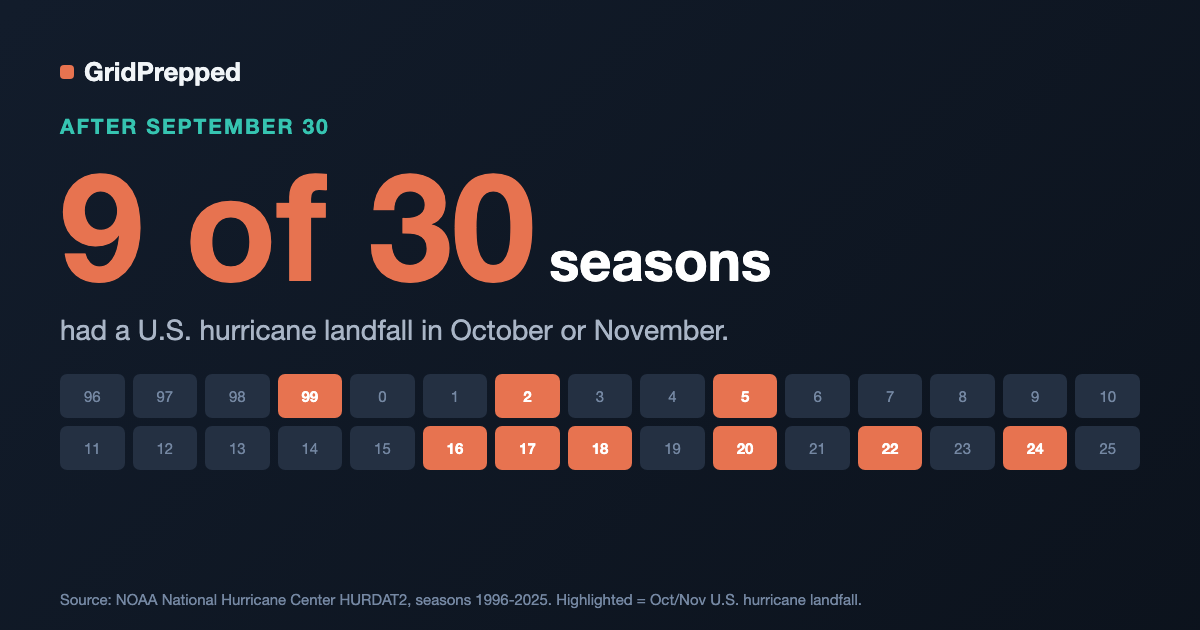
9 of the last 30 hurricane seasons had a U.S. landfall in October or November. NOAA data, and how to check your supplies and alerts before then.
September 30 feels like a finish line. The kids are in school, the pumpkin spice is out, and the hurricane supplies that got bought in June are somewhere in the garage, in whatever condition the garage left them. The calendar says the season runs through November 30, and the record says that's not a technicality.
I pulled the National Hurricane Center's HURDAT2 database, which logs every Atlantic storm since 1851, and counted U.S. hurricane landfalls over the 30 seasons from 1996 through 2025. The National Hurricane Center's data page explains the format. Each storm counts once, at its first landfall record at hurricane strength on the U.S. coast.
The late-season number
That gives 55 storms. Ten of them, about one in six, came ashore in October or November.
| Month of first U.S. hurricane landfall | Storms | Share |
|---|---|---|
| July | 10 | 18% |
| August | 14 | 25% |
| September | 21 | 38% |
| October | 9 | 16% |
| November | 1 | 2% |
The more useful cut is by season. Nine of those 30 seasons had at least one U.S. hurricane landfall in October or November: 1999, 2002, 2005, 2016, 2017, 2018, 2020, 2022 and 2024. That's 30 percent. If you plan your supplies around "the season is over on September 30," you'd have been early in nearly one year out of three.
Two methodology notes. I used a rough coastal box to keep Bermuda, Nova Scotia and the Caribbean out of the count, so treat 55 as approximate by a storm or two rather than exact. And HURDAT2 timestamps are in UTC, so a landfall late in the evening on the East Coast can appear as the next calendar day.
Two Octobers, two weeks apart in one case
Hurricane Michael reached the Florida Panhandle on October 10, 2018, at 140 knots, about 160 mph, which is the top of the scale. Hurricane Milton crossed Florida's west coast in the night of October 9-10, 2024. Milton came less than two weeks after Helene had made landfall on the Gulf Coast on September 26 local time (September 27 UTC in the database). Whatever a household had on the shelf after Helene, it needed a second look before Milton.
That second look is the part people skip. Supplies bought for an early-season storm get used, borrowed or forgotten, and the second storm arrives with the shelf in an unknown state. Batteries, water, the medication buffer, the can of formula: each has a date, and the dates don't care what month it is.
This is what the supply tracker is for. It keeps your emergency supplies with their expiration dates in one place, so "did we restock after Helene?" has an answer you can look up. After a storm passes, or once September ends, going through the list tells you what to replace before the next one gets a name.
Your family isn't in one zip code
Hurricane Zeta reached the Louisiana coast on October 28, 2020. Late storms often reach places that have relaxed for the year: the Gulf Coast in late October, Florida's east coast in November, when Nicole came ashore on November 10, 2022.
Now the possibility. Your parents live in Pensacola. You live in Denver. Their coast gets a late-October storm, and you hear about it Tuesday afternoon from a group text. GridPrepped's per-location alerts let you watch up to five places for email alerts, each with its own severity setting: off, severe only, or moderate and up. You could watch your own zip at severe only and your parents' at moderate and up, and get one digest email that covers all of them.
The same logic covers a college student or a second home. The point is that the warning finds you even when the storm isn't near you.
Keep a kit that isn't tied to a month
Michael and Milton both drove evacuations. An evacuation is the moment a household finds out whether its go bag is a real thing or a plan. The evacuation kit tracker lets you build the kit, date it, and keep it current on your own schedule. A kit assembled in May and never touched again is the same problem as a shelf of expired supplies, one level up.
If you have a kit already, an October check is a good time to look at it: change the clothes for the season, swap the documents that have changed, and see what has expired.
What to do this week
Three things, and none of them takes long.
- Audit what you have. Put your water, batteries, food and medications into the supply tracker with their dates. Anything expired or close to it goes on a replacement list.
- Set alerts for the people you'd worry about. Add the addresses that matter, up to five, and choose a severity for each so the email stays useful instead of noisy.
- Date your go bag. Note the day you last checked it, and pick the day you'll check it again.
None of this predicts a storm. Nobody can say whether this October brings a landfall, and most Octobers in the 30-year window didn't. The record only says the door isn't closed on September 30, and that getting your shelf in order in early October costs a lot less than doing it with a cone on the news.
Log in and start with the supply tracker. It takes a few minutes to enter what's in the closet, and it's the check that's easy to put off until the season is officially over. In this data, that day is November 30.
Sources
- NOAA National Hurricane Center, HURDAT2 Atlantic hurricane database, 1851-2025: https://www.nhc.noaa.gov/data/hurdat/hurdat2-1851-2025-02272026.txt
- NOAA National Hurricane Center, hurricane data archive: https://www.nhc.noaa.gov/data/#hurdat
- Counts computed by GridPrepped from HURDAT2: first U.S. landfall record at hurricane status, 1996-2025, 55 storms.
Build your household's emergency plan
Free, and built around where you live.