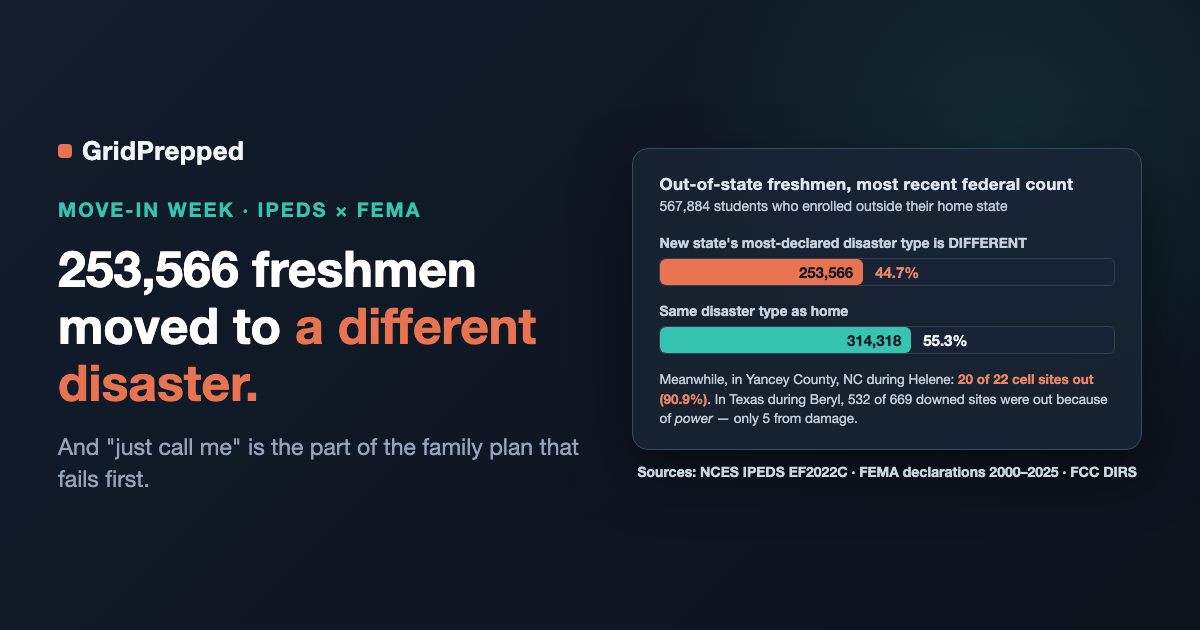
253,566 College Freshmen Moved to a Different Disaster
We joined federal student-migration data to FEMA declarations: 44.7% of out-of-state freshmen now live where the top disaster type differs from home.
Move-in week is a logistics problem. Mini fridge, roommate, parking pass. Nobody in the loading zone is thinking about hazard profiles.
They probably should be, because a household that splits across state lines quietly stops sharing an emergency plan. Not the paperwork — the assumptions. The kid who grew up doing wildfire evacuation drills now lives somewhere the power goes out for four days after a summer thunderstorm, and nobody ever mentioned that.
We wanted to know how often that actually happens, so we computed it.
The number nobody publishes
The Department of Education's IPEDS survey asks every college where its first-time freshmen came from. In the most recent complete collection — fall 2022, 5,385 institutions — 2,760,183 first-time degree-seeking freshmen had a known home state, and 567,884 of them (20.6%) enrolled outside it.
That part is well known. The next step isn't.
We joined those 2,580 home-state-to-campus-state flows against every federal disaster declaration from 2000 through 2025 (3,390 of them, from FEMA's declarations API) and asked a simple question: is the disaster type your new state gets declared for most often the same one your home state does?
For 253,566 students — 44.7% of everyone who went out of state — the answer is no.
The finding holds up. The partial fall 2023 collection, an entirely separate release covering 2,166 institutions, comes out at 43.0%. Two datasets, same answer.
The flows aren't random, either. A few states are big net importers of out-of-state freshmen — Arizona takes in about 19,600 more than it sends away, New Hampshire about 12,300, Indiana about 9,700. The biggest net exporters are New Jersey (about 29,500 more out than in), California (about 26,000) and Texas (about 25,000). Those corridors are where hazard profiles diverge hardest.
Here are the biggest single swaps:
| Freshmen | From (most-declared) | To (most-declared) |
|---|---|---|
| 3,903 | California (Fire) | New York (Severe Storm) |
| 3,705 | Texas (Fire) | Arkansas (Severe Storm) |
| 3,338 | Georgia (Hurricane) | Alabama (Severe Storm) |
| 3,009 | Maryland (Hurricane) | Pennsylvania (Severe Storm) |
| 2,590 | Georgia (Hurricane) | Tennessee (Severe Storm) |
| 2,549 | New York (Severe Storm) | Florida (Hurricane) |
| 2,265 | California (Fire) | Massachusetts (Severe Storm) |
| 2,026 | Texas (Fire) | Louisiana (Hurricane) |
Two honest caveats. This measures how often a state gets *declared* for something, not how dangerous that something is. And Fire counts run high in western states partly because Fire Management Assistance grants are much easier to obtain than a full major-disaster declaration — so California's 275 Fire declarations and New York's 26 Severe Storm declarations aren't an apples-to-apples severity comparison. The direction of the finding survives either way: the hazard your kid was raised around usually isn't the one they're living in now.
"Just call me" is the plan that breaks first
Ask most families what their emergency plan is and you'll get a version of "call me." That is the piece the data says fails soonest.
The FCC collects cell-site outage reports county by county during declared disasters. From its Hurricane Helene report dated October 1, 2024: in Yancey County, North Carolina, 20 of 22 cell sites were out — 90.9%. Mitchell County, 18 of 20. Henderson County, 116 of 158. Buncombe County, home to Asheville, 215 of 348. Across the North Carolina disaster area, 707 of 1,452 sites were down, and cable and wireline providers reported 796,999 subscribers without phone, TV, or internet.
The FCC's own footnote deserves quoting, because it keeps this honest: "The number of cell site outages in a specific area does not necessarily correspond to the availability of wireless service to consumers in that area." Overlapping towers, portable cells, and roaming agreements all soften the real-world impact. Fine. Ninety percent of a county's towers is still a bad night to be relying on a phone call.
And the cause is the part that matters most. The FCC's Hurricane Beryl report from July 11, 2024 breaks Texas outages down by reason: of 669 cell sites out across six counties, 532 were out because of power. Thirty were transport. Five were actual damage. Another 463 were still running, on backup batteries with a clock on them.
The cell network mostly doesn't get destroyed. It just runs out of electricity, right when everyone decides to call home. That is also why a communications plan and an outage plan are the same plan — a fact that gets missed when families treat "can't reach you" and "power's out" as two separate problems.
What to actually do this week
Three things, none of which take an afternoon.
Look up the campus hazard, not the home one. GridPrepped's hazard lookups take a ZIP code and tell you what that specific location is exposed to — hurricane, flood, wildfire, tornado, and earthquake. Run the dorm ZIP. If it comes back different from home, that gap is the whole point of this article.
Give the student their own plan, then share it. This is the part that fixes the split-household problem. A student builds a plan for where they actually live at gridprepped.com/plan — ZIP, household size, own or rent — and then shares it with their parents, so both halves of the family can see both plans in the family dashboard. One plan for two states was never going to work. Two linked plans do.
Write down one thing that isn't a phone call. An out-of-area text contact, a meeting point, a "if you don't hear from me by X, assume Y." Text messages often squeeze through when calls won't, and a plan saved in your GridPrepped account is still there when the battery isn't.
The move-in logistics get handled because there's a deadline. This one has no deadline, which is exactly why it's still undone in October.
Sources
- IPEDS Fall 2022 Residence and Migration (EF2022C) and Institutional Characteristics (HD2022), National Center for Education Statistics: https://nces.ed.gov/ipeds/use-the-data
- OpenFEMA FemaWebDisasterDeclarations API: https://www.fema.gov/api/open/v1/FemaWebDisasterDeclarations
- FCC Communications Status Report, Hurricane Helene, October 1, 2024: https://docs.fcc.gov/public/attachments/DOC-406055A1.pdf
- FCC Communications Status Report, Hurricane Beryl, July 11, 2024: https://docs.fcc.gov/public/attachments/DOC-403893A1.docx
Build your household's emergency plan
Free, and built around where you live.