Hawaii Island Averages Nine Hours Without Power a Year. Parts of It Are Now Looking at Weeks.
Hawaiian Electric is telling rural Hawaii Island customers to expect weeks. Federal data shows why "a few days" is the wrong number to plan around.
On Sunday morning, Hawaiian Electric published a sentence that most utilities try very hard never to write: customers should "prepare for extended outages lasting weeks or even months in the hardest hit rural areas of Hawaii Island."
Tropical Storm Lala is gone. The National Weather Service in Honolulu canceled the last of its warnings and issued its final tropical statement for the storm. The wind stopped days ago. The outage did not.
That gap — between the storm ending and the power returning — is the part almost nobody plans for. And there's a federal dataset that explains exactly why.
Four out of five outage minutes come from a handful of days
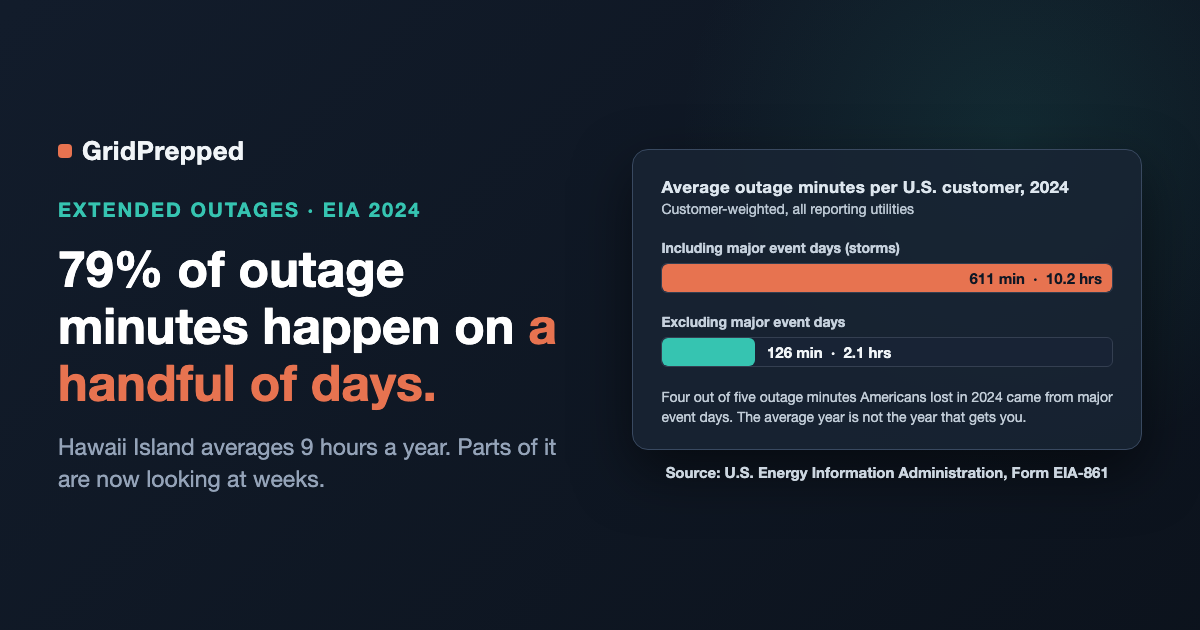
Every utility in the country reports its reliability numbers to the U.S. Energy Information Administration on Form EIA-861. Two of those numbers sit right next to each other and are almost never compared: average outage minutes per customer including "major event days," and the same figure excluding them.
I pulled the raw 2024 reliability file and weighted every utility by its customer count. The result:
- Including major event days, the average U.S. customer lost 611 minutes of power in 2024 — about 10 hours.
- Excluding them, the same average is 126 minutes — about 2 hours.
Roughly 79% of all the outage minutes Americans experienced in 2024 happened on major event days — the storms, the ice, the hurricanes. On a normal Tuesday the grid is extraordinarily reliable. The entire risk is concentrated into a few days a year that look nothing like the average.
Hawaii Island makes the point cleanly. In that same dataset, Hawaii Electric Light Company — the Big Island utility — reported 539.75 minutes of outage per customer for all of 2024. That's about nine hours for the whole year.
Fourteen days without power is 336 hours. That's roughly 37 times Hawaii Island's entire average outage year, delivered in one event. Nationally, two weeks out is about 33 times the average American's whole outage year.
This is why "we lose power sometimes and it's fine" is a bad basis for a plan. Your normal years don't resemble your bad week even slightly.
The counter that goes up while crews are winning
Here's the second thing this week demonstrated, straight from Hawaiian Electric's own updates.
Saturday evening, about 88,000 customers were out across three islands. By Sunday late morning, that number had climbed to more than 250,900 — because the storm had moved on to Oahu while Hawaii Island was still broken. By Sunday afternoon the utility reported it had restored nearly 180,000 customers, and that about 191,800 were still without power.
Both numbers were true at the same time. Crews were succeeding and the outage was still enormous.
For a household, the practical translation is that early restoration numbers tell you almost nothing about your own timeline. Utilities repair transmission backbone first, then substations, then the circuits serving the most people. If you're on a rural spur at the end of a 42-mile stretch of downed line — as Hawaii Island's Hamakua coast was — you are, by design, near the end of the queue. Hawaiian Electric also requested roughly 100 crew members from mainland utilities through its mutual assistance group; they were expected to arrive Tuesday and start work Wednesday. Four days after landfall. (Why help moves that slowly to an island is its own structural story.)
The 14-day version of your plan, with actual arithmetic
Hawaii is the only state whose emergency managers officially tell residents to hold 14 days of supplies rather than the usual three — because, as HI-EMA puts it, the state "relies on shipping for most of its food and supplies." But the arithmetic below isn't a Hawaii thing. Any household on a rural circuit after a major storm can end up in the same math.
Using federal guidance numbers — one gallon of water per person per day from Ready.gov, and a published spec sheet for a common 2,200-watt inverter generator — here's what stretching from 72 hours to 14 days actually costs a family of four:
| What you're storing | 72-hour plan | 14-day plan |
|---|---|---|
| Water, drinking and sanitation (gallons) | 12 | 56 |
| Equivalent cases of bottled water (24 × 16.9 oz) | 4 | 18 |
| Shelf-stable meals, 3 per person per day | 36 | 168 |
| Generator gasoline, 8 hrs/day at light load (gallons) | 3 | 13 |
| Generator gasoline, 8 hrs/day at rated load (gallons) | 7 | 33 |
| Days your fridge and full freezer cover | 2 | 2 |
Three things jump out of that table.
Water is the heavy one. Fifty-six gallons weighs about 470 pounds and takes up real floor space. Nobody buys that in one trip during a watch. It's a build-a-little-each-week item, which is exactly what HI-EMA recommends.
Your refrigerator is a two-day appliance. Ready.gov's numbers are four hours for an unopened fridge and about 48 hours for a full freezer. In a 14-day event, refrigeration covers day one and day two. Days three through fourteen are shelf-stable or they don't happen.
Generator fuel math is brutal and rarely done. Most households that own a generator store five gallons. At a light load that's about four days of partial-day running; at rated load it's under two. Stretching two weeks means either a much larger fuel plan or a much smaller definition of what you run — and gas stations need electricity to pump. Worth remembering that the Consumer Product Safety Commission estimates about 100 people die each year from carbon monoxide poisoning caused by portable generators; the standing guidance is outdoors only, at least 20 feet from windows and doors, with working CO alarms inside.
Medication is the item with a real deadline
Food and water are volume problems. Refrigerated medication is a clock problem, and the actual numbers are more forgiving than most people assume — which makes them worth knowing before you throw something away.
Per FDA guidance, insulin in manufacturer vials or cartridges, opened or unopened, may be left unrefrigerated between 59°F and 86°F for up to 28 days and continue to work. Insulin in a pump's infusion set should be discarded after 48 hours. The FDA also notes insulin loses effectiveness with exposure to extreme temperatures, and that frozen insulin should not be used.
The point isn't to self-manage medication from a blog post — ask your pharmacist or physician what your specific prescriptions tolerate. The point is that this is a question with a knowable answer, and finding the answer takes five minutes on a normal day and is nearly impossible on day three of an outage with no cell service.
Same logic for powered medical equipment. A CPAP or a nebulizer turns "the power is out" into a medical problem, and HI-EMA's guidance is blunt about envisioning that scenario in advance, including a battery or power-bank backup.
What to write down before your bad week
The households that do well in long outages aren't the ones with the most gear. They're the ones who decided in advance what number they were planning for.
GridPrepped's plan builder exists for exactly this: pick your target — 3 days, 7, 14 — and it holds the supply math, medication list, documents, routes, and who-checks-on-whom in one place you can open on a phone with no signal. The alerts side watches NWS and NHC products for your location, so a watch reaches you while stores still have inventory rather than after.
Neither shortens a restoration timeline. What they can do is make sure the number you planned around isn't the average year — because the EIA data is clear that the average year is not the one that gets you.
If you do one thing today: decide how many days your household is actually prepared for, then check one item against that number. Water is the honest place to start.
---
Sources
Hawaiian Electric, storm updates for Tropical Storm Lala, Aug. 15–16, 2026 (outage counts by island; extended-outage warning; mutual assistance request)
https://www.hawaiianelectric.com/about-us/newsroom
NWS Honolulu, Tropical Cyclone Local Statement for Lala (final statement; all watches and warnings canceled), Aug. 16, 2026
https://api.weather.gov/alerts/active?area=HI
Central Pacific Hurricane Center, Tropical Storm Lala Public Advisory 20, Aug. 16, 2026
https://www.nhc.noaa.gov/text/HFOTCPCP2.shtml
U.S. Energy Information Administration, Form EIA-861 Annual Electric Power Industry Report, 2024 reliability file (Reliability_2024.xlsx; SAIDI with and without major event days, customer-weighted by GridPrepped)
https://www.eia.gov/electricity/data/eia861/
Hawaii Emergency Management Agency, "2-Weeks Ready in Hawaiʻi"
https://dod.hawaii.gov/hiema/2-weeks-ready-in-hawai%CA%BBi/
Ready.gov, Water and Power Outages preparedness pages (one gallon per person per day; four-hour refrigerator, 48-hour full freezer; generator 20-foot guidance)
https://www.ready.gov/water
U.S. Consumer Product Safety Commission, portable generator carbon monoxide fatality estimate
https://www.cpsc.gov/Newsroom/News-Releases/2025/As-Winter-Storms-Threaten-Millions-in-the-US-CPSC-Issues-Safety-Tips-to-Help-Families-Prevent-Carbon-Monoxide-Poisoning-and-Fires
U.S. Food and Drug Administration, Information Regarding Insulin Storage and Switching Between Products in an Emergency
https://www.fda.gov/drugs/emergency-preparedness-drugs/information-regarding-insulin-storage-and-switching-between-products-emergency
Honda Power Equipment, EU2200i specifications (0.95-gal tank; 3.2 hrs at rated load, 8.1 hrs at 1/4 load)
https://powerequipment.honda.com/generators/models/eu2200i
Build your household's emergency plan
Free, and built around where you live.