Four Weeks After Iniki, Only 20% of Kauai Had Power Back. The Wind Wasn't the Reason.
A Hurricane Warning is up for Hawaii Island. Hawaii's six grids aren't connected to each other — and that's what sets outage length, not wind speed.
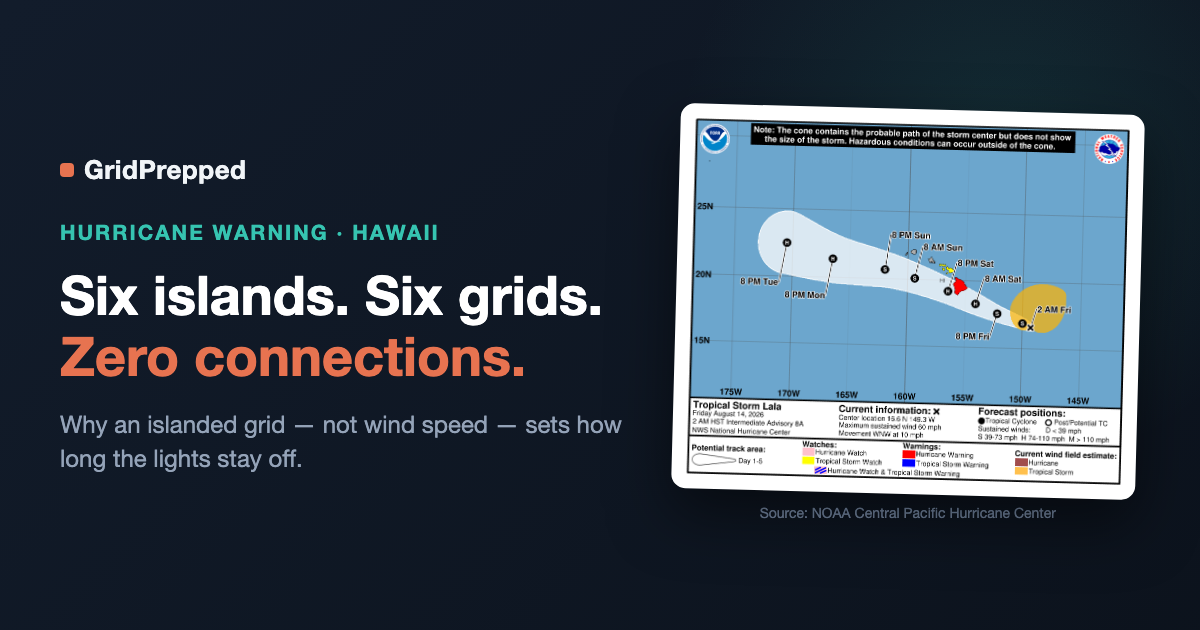
As of Friday morning, August 14, 2026, the National Weather Service has a Hurricane Warning in effect for the Big Island of Hawaii — Kona, Kohala, and the island's east, north, south, southeast, interior, and summit zones. Tropical Storm Lala was about 455 miles east-southeast of Hilo with 60 mph sustained winds, forecast to strengthen into a hurricane as it approaches, and to pass directly over or just south of the island on Saturday. A Tropical Storm Watch covers Maui County.
Forecast rainfall is 8 to 12 inches across the Big Island and parts of Maui, with isolated windward spots possibly over 20 inches. NWS Honolulu's impact language includes a line most people skim past: "Locations may be uninhabitable for weeks," and "Large areas with power and communications outages."
Weeks. Not days. And there's a specific, structural reason Hawaii outages run long that has almost nothing to do with how hard the wind blows.
Six islands, six grids, zero connections
Here is the fact that reframes every Hawaii storm: the islands are not electrically connected to each other.
The Hawaii Public Utilities Commission states it plainly — "Each of Hawaii's six main islands has its own electrical grid, not connected to any other island." Four regulated electric utilities serve the state. The HECO companies cover about 95% of the population; Kauai's cooperative covers the rest.
That sentence carries enormous weight during a hurricane. On the mainland, the recovery playbook leans on two things: high-voltage interconnections that let neighboring systems feed power into the damaged area, and mutual-aid convoys — hundreds of line trucks that drive in from three states away, often staged before landfall.
Hawaii Island gets neither. There is no wire from Oahu. There is no interstate for a Utah crew to drive down.
Per Hawaiian Electric's own Power Facts page, Hawaii Island serves 91,234 customers with about 280.5 MW of firm generating capacity — every megawatt of it physically on that island. Statewide, Hawaiian Electric reports 474,241 total customers as of December 31, 2025. If Hawaii Island's transmission and distribution network takes a serious hit, the repair has to be made with the poles, transformers, wire, fuel, and crews already sitting on that island — plus whatever arrives afterward by barge or cargo plane, through ports and airports that just took the same storm.
Outage duration isn't only a function of storm intensity. It's a function of restoration logistics. And in an islanded grid, logistics is the binding constraint.
What Iniki actually cost, in weeks
Hurricane Iniki hit Kauai on September 11, 1992 — still the benchmark event for the state.
The Central Pacific Hurricane Center's 1992 tropical cyclone report documents the damage: 14,350 homes damaged or destroyed on Kauai per Red Cross figures, 1,421 completely destroyed, 5,152 with major damage. Then this line, which is the whole point of this article:
"Electric power and telephone service were lost throughout the island and only 20 percent of power had been restored four weeks after the storm."
Four weeks in, four out of five customers were still dark. Not because crews were idle — because rebuilding an island's entire distribution network means importing most of the material and labor to an island whose harbor and airport were also just wrecked.
Kauai's grid was smaller than Hawaii Island's, and 1992 was a long time ago; utilities have hardened equipment and improved staging considerably since. Lala is not Iniki, and nobody should read a 1992 outcome as a 2026 forecast. But the structural constraint — no interconnection, no drive-in mutual aid — hasn't changed, because geography hasn't changed.
The rarity problem nobody plans for
I pulled every federal disaster declaration for Hawaii from FEMA's OpenFEMA API. Since 1953, Hawaii has had 72 unique declared disasters. Broken out by incident type:
| Incident type | Unique declarations |
|---|---|
| Fire | 29 |
| Flood | 13 |
| Severe Storm | 9 |
| Hurricane | 6 |
| Volcanic Eruption | 4 |
| Earthquake | 4 |
| All others | 7 |
Six hurricane declarations in roughly seven decades. Only three of those were full major disaster declarations — Hurricane Dot (1959), Iniki (1992), and Lane (2018). The other three were emergency declarations: Lane's initial one in August 2018, Tropical Storm Olivia in September 2018, and Hurricane Douglas in July 2020.
The obvious read is "Hawaii rarely gets hit." The more useful read is the opposite: rarity is itself a risk factor. Roughly one major hurricane declaration per generation means most households have never rehearsed one. Supplies haven't been rotated. Nobody knows where the flashlights ended up. A Gulf Coast family that has evacuated four times has muscle memory; a family whose island last did this in 1992 does not.
Low frequency plus long restoration is the hardest combination to prepare for — and the one where writing a plan down in advance pays the most.
What to actually do with this
Whether you're in Hilo this weekend or in a mountain town on the mainland at the end of a single distribution line, the islanded-grid lesson generalizes: plan for the restoration timeline your location can support, not the national average.
- Stretch the supply horizon. The standard "three days" advice is calibrated for places where mutual-aid crews drive in. If you're at the end of a supply chain that arrives by boat, ferry, or one mountain highway, consider planning toward two weeks of water, food, and medication instead.
- Sort out prescriptions and medical power now, not Saturday. Refills, coolers for refrigerated meds, and battery backup for anything medical are the items that become impossible to source mid-event.
- Charge and cache everything today. Power banks, headlamps, and a battery or hand-crank radio for NOAA Weather Radio when cell sites run out of generator fuel.
- Cash and a full fuel tank. Card readers and pumps both need electricity.
- Photograph your property before the storm. Five minutes now makes insurance claims dramatically easier later.
- Write down two out-of-area contacts. Local networks fail first; a mainland relative as a message relay is a cheap fix.
- Check on two neighbors — especially anyone elderly or dependent on powered medical equipment. Long outages hurt those households first and worst.
Where GridPrepped fits
Your plan is a written, location-aware checklist you can build before a warning is issued — supplies, medications, documents, contacts — so the decisions get made on a calm Tuesday instead of during a 2 a.m. advisory update. If you live somewhere with a long restoration tail, that's exactly where a longer supply horizon belongs.
Alerts exist because Lala's Hurricane Warning was posted well before conditions started deteriorating. That lead time is the most valuable resource in the event, and it only helps if the warning reaches you while stores are still open and the airport is still running.
If you're in the warning area this weekend, follow NWS Honolulu and your county emergency management office — they supersede anything you read here. Don't focus on the exact forecast track; NWS is explicitly advising against that, and impacts extend well beyond the center.
And if you've never lost power for two weeks: the Iniki number is worth remembering anyway. Twenty percent, four weeks later. That's what a long restoration tail looks like, and it's a better argument for a written plan than any wind speed.
Sources
- NWS Honolulu / Central Pacific Hurricane Center, Tropical Storm Lala public advisory and Tropical Cyclone Local Statement, August 14, 2026: https://www.nhc.noaa.gov/graphics_cp2.shtml and https://api.weather.gov/alerts/active?area=HI
- Hawaii Public Utilities Commission, Energy: https://puc.hawaii.gov/energy/
- Hawaiian Electric, Power Facts (customers and firm capacity as of 12/31/2025): https://www.hawaiianelectric.com/about-us/power-facts
- NOAA Central Pacific Hurricane Center, 1992 Seasonal Tropical Cyclone Report (Iniki restoration figures): https://www.nhc.noaa.gov/data/tcr/CP1992_Seasonal_TCR.pdf
- FEMA OpenFEMA, Disaster Declarations Summaries, queried August 14, 2026: https://www.fema.gov/about/openfema/data-sets
Build your household's emergency plan
Free, and built around where you live.