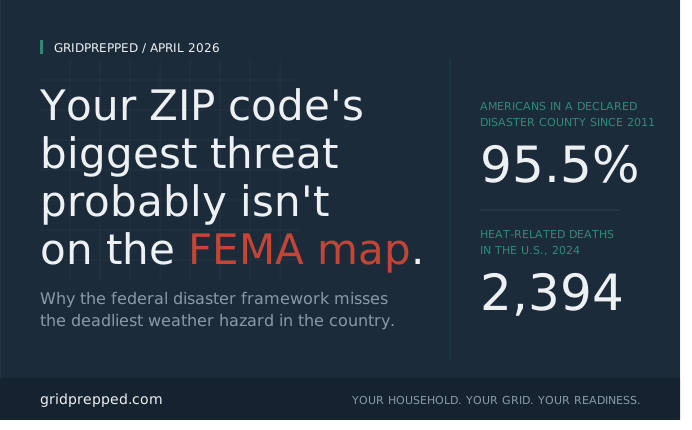
Your ZIP Code's Biggest Threat Probably Isn't on the FEMA Map
Most people check disaster risk the same way — pull up the FEMA map, see if their county's been declared, feel better or worse, move on. That reflex is broken two ways. The map is saturated, and the deadliest weather hazard in the country isn't on it.
The FEMA Map Is Basically the Whole Country
Between 2011 and 2024:
95.5% of Americans lived in a county with at least one major disaster declaration
99.5% of congressional districts had one
In 28 states, every single county got declared
(Rebuild by Design, Atlas of Disaster, 2024)
When the map is that red, it stops telling you anything useful.
The Deadliest Weather Hazard Isn't on It
There has never been a presidentially declared major disaster for extreme heat. Not once, in the entire history of the federal disaster declaration program. (U.S. GAO, Sept. 2025)
Why: the Stafford Act ties declarations to infrastructure damage. Heat doesn't snap power lines or rip roofs off. FEMA officials told the GAO that "absent extraordinary circumstances, it was unlikely that a president would ever declare a major disaster for extreme heat." (U.S. GAO, Sept. 2025)
Meanwhile — heat is killing more Americans than any other weather event. More than hurricanes, floods, and tornadoes combined. (CDC; WMO)
2,325 heat deaths in 2023 — the highest on record. (JAMA, Aug. 2024)
2,394 in 2024. Record-adjacent. (CDC via ABC News, July 2025)
117% increase in heat-related deaths, 1999–2023. (JAMA, Aug. 2024)
~120,000 ER visits for heat illness in 2023. 92% of them May–September. (CDC, April 2024)
The deadliest weather-related hazard in the country is the one the federal disaster framework is structurally incapable of recognizing.
Why That Matters for Household Prep
If you built your plan around "what FEMA declared in my area," you have two problems:
Everywhere's been declared something. Signal is noise.
The thing most likely to kill someone in your house during summer isn't in that dataset at all.
Heat doesn't arrive as a named storm. No evacuation order. No 2 AM alert on your phone. It just gets hot, stays hot, and your AC either keeps running or it doesn't. People who die from heat mostly die at home — often with a fan running, no AC, no sense they're in trouble until it's too late. (NYC Dept. of Health, 2024 Heat Mortality Report)
That's a grid-dependency problem, not a disaster-response problem. Which makes it our problem.
What GridPrepped Pulls That FEMA Doesn't
The free threat review at gridprepped.com pulls from multiple federal datasets against your ZIP — not just FEMA declarations. Historical outage patterns, hazard exposure, grid reliability, and the vulnerability factors that turn a heat wave into a fatality: AC dependency, powered medical equipment, household isolation risk.
It's not replacing the FEMA map. It's showing you what the map leaves out.
For most households, the most useful output isn't "you're in a disaster zone" — it's a specific list of single points of failure you hadn't thought about. Starting with: what happens in your house if the grid drops on a 98-degree afternoon in July?
Do This Now
Run your ZIP threat review at gridprepped.com. Five minutes. Free.
When you get your report, check three things:
Cooling redundancy — one AC is a single point of failure. What's your backup when it fails during a heat wave?
Powered medical equipment — CPAPs, oxygen concentrators, refrigerated meds. Grid drops 12 hours, then what?
Heat-vulnerable household members — elderly, infants, anyone on meds that impair thermoregulation (common blood pressure meds, antidepressants, antihistamines).
Heat won't show up on your FEMA map. Make sure it shows up on your plan — before summer 2026 tells you what you missed.
Sources
Rebuild by Design — Atlas of Disaster / Atlas of Accountability, 2024. rebuildbydesign.org
U.S. Government Accountability Office — Extreme Heat: Limited FEMA Assistance Highlights Need for Reevaluation of Agency's Role, GAO-25-107474, Sept. 30, 2025. gao.gov
Howard, J.T. et al. — Trends of Heat-Related Deaths in the US, 1999-2023, JAMA, Aug. 2024.
Centers for Disease Control and Prevention — Heat-related ER visits, annual mortality data, 2023–2024. cdc.gov
ABC News / CDC data — U.S. heat death statistics, July 2025.
NYC Department of Health and Mental Hygiene — 2024 Heat Mortality Report. nyc.gov
World Meteorological Organization — Extreme heat as #1 weather-related killer, 2024.
Build your household's emergency plan
Free, and built around where you live.