Your Emergency Plan Has One Address. On a Workday, Your Family Has Six.
Census commuting flows: 27.2% of US workers leave their county each workday, and the median county scatters them into six. Plan for that.
A storm that showed up during business hours
Tropical Depression Edouard is crawling across east Texas this morning at 5 mph with 35 mph winds. Nobody will remember the wind speed. What matters is that it is a Wednesday, the storm is slow, and the people underneath it are scattered across their working lives — desks, job sites, classrooms — not at the addresses their emergency plans were written for.
That gap is measurable, so I measured it.
The commuting file nobody reads
The Census Bureau publishes county-to-county commuting flows from the American Community Survey. The current edition covers 2016–2020 and holds 122,339 residence-county-to-workplace-county pairs. I pulled the whole file and totaled it for the 50 states and DC.
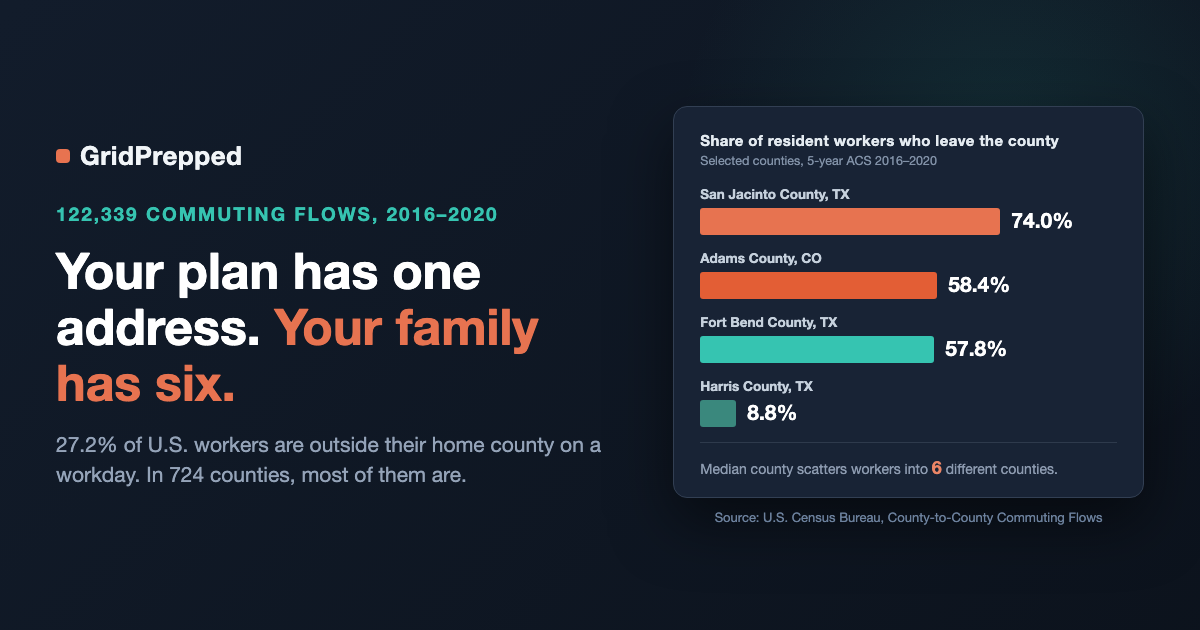
153,665,654 workers. 41,850,068 of them — 27.2% — work outside the county they live in. Another way to say it: 5,531,225 Americans cross a state line to go to work. And in 724 of 3,144 counties, most working residents leave the county every single workday.
Then the number that reframes the whole thing. For every county with at least 1,000 workers, I counted how many different workplace counties absorb at least 1% of its residents. The median answer is six. Three-quarters of US counties scatter their workers into five or more.
Two caveats, both of which push the same direction. People who work from home count as working in their own county, and this window includes 2020. The real weekday scatter is wider than the file says, not narrower.
| County (resident workers) | Work outside the county |
|---|---|
| San Jacinto County, TX (10,491) | 74.0% |
| Chambers County, TX (19,762) | 65.4% |
| Adams County, CO (261,805) | 58.4% |
| Fort Bend County, TX (371,892) | 57.8% |
| Douglas County, CO (183,418) | 49.3% |
| Harris County, TX (2,209,641) | 8.8% |
Computed from Census county-to-county commuting flows, 2016–2020 ACS.
Look at Harris County at 8.8% sitting next to Fort Bend at 57.8%. A large county with its own job base keeps its people inside the lines. The suburb next door empties out by 8 a.m. Same metro, opposite exposure.
Three events that ran this experiment
Edouard's center this morning is near San Jacinto County, Texas, where 74% of working residents commute out. Whatever the storm does there, it does to a county whose adults are mostly somewhere else.
The same region already ran the harder version. Hurricane Beryl came ashore July 8, 2024 and left roughly 2.7 million Texas customers without power, some for close to two weeks, in July heat. Fort Bend County sends 57.8% of its workers into other counties. Restoring power to a house is one problem; getting a person back to that house, across county lines and dead traffic signals, is a different one — and an alert aimed only at your home ZIP tells you nothing about the county you are actually standing in. GridPrepped's alerts let you watch up to five locations, each with its own severity setting. Your home ZIP at "Moderate and up," your spouse's work county at "Severe only," and you get one grouped email instead of five.
And Colorado's most destructive fire did not wait for a weekend. The Marshall Fire began on the morning of Thursday, December 30, 2021 and destroyed 1,084 homes in Boulder County before the day was out (FEMA DR-4634). Next door, Adams County sends 58.4% of its workers away each morning. When a fire moves in a single afternoon, the plan has to be readable by whichever adult is closest to the kids — not the one who wrote it. That is what the family dashboard and plan sharing are for: the other person gets the actual plan, not a text that says "call me."
Four things worth doing this week
Write down where everyone actually is. Not "home." The real weekday addresses: office, campus, job site, daycare, the gym at 6 a.m. Most families have never said these out loud in one sitting.
Count your dots, then watch them. If your household covers three counties on a Tuesday, one ZIP code of warning is covering a third of your problem. Add the other locations and set severity per location so the far-away ones do not spam you.
Pick the rally point before you need it. One in-town spot, one out-of-town spot, and one out-of-state contact everybody can text when local lines are jammed. Store it somewhere retrievable — a saved emergency plan you can pull up on a phone beats a plan that lives in one person's memory.
Assume the commute is the failure point. Fuel above a quarter tank, comfortable shoes at work, a charged battery pack in the bag. The scenario is not "we're trapped at home." It is "we're 30 miles apart and the interstate is closed."
The point
Emergency planning is built around a house. The Census data says that on an ordinary workday, the median American county sprays its working residents into six different counties, and in 724 counties the majority are gone. A plan that only works when everyone is under one roof is a plan for evenings and weekends.
Fix the assumption first. The supplies can wait a week; knowing where your people are cannot.
Sources: Census Bureau, County-to-County Commuting Flows 2016–2020 (Table 1); National Hurricane Center advisories on Tropical Depression Edouard, September 2, 2026; FEMA disaster declaration DR-4634 (Colorado, Marshall Fire).
Build your household's emergency plan
Free, and built around where you live.