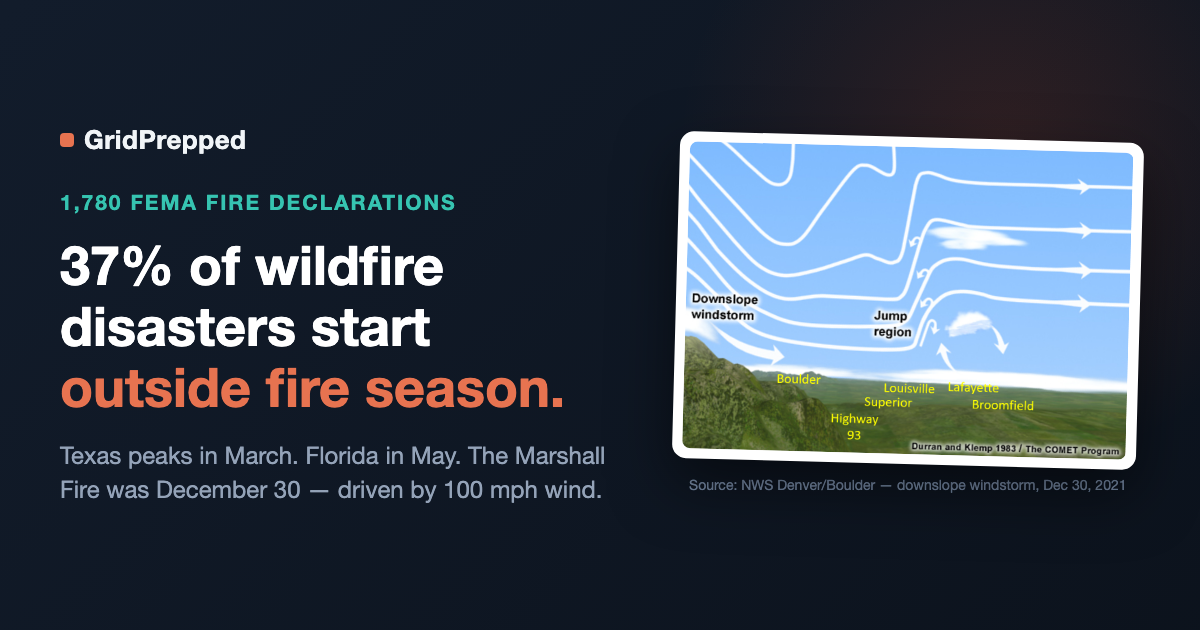
37% of Wildfire Disasters Don't Start During Fire Season
I counted 1,780 FEMA fire declarations: 37% began outside June-September. Texas peaks in March, Florida in May. Why wind, not heat, is the signal.
"Fire season" is a useful phrase if you're staffing hotshot crews or staging air tankers. It's a bad phrase for planning your own household, because the federal record doesn't really support it.
I pulled every wildfire disaster declaration in FEMA's OpenFEMA database — incident type "Fire," 1953 through today — and grouped 1,780 unique declarations by the month the incident actually began. Here's the number that stopped me: 37% of them began outside the June-through-September window most people picture as fire season.
Narrow it to the biggest events — the 107 that escalated to a Major Disaster or Emergency Declaration instead of a fire management assistance grant — and the off-season share goes *up*, to 44%.
Fire season isn't one season. It's a dozen.
National totals hide the part you can actually use. Broken out by state, several large states don't peak in summer at all.
| State | Fire declarations | Peak month | Share beginning outside Jun–Sep |
|---|---|---|---|
| California | 299 | Aug | 36% |
| Texas | 270 | Mar | 65% |
| Washington | 155 | Jul | 3% |
| Oklahoma | 139 | Mar | 76% |
| Oregon | 129 | Aug | 1% |
| Colorado | 85 | Jun | 29% |
| Florida | 69 | May | 77% |
Washington and Oregon are the states the stereotype was built for — 97% and 99% of their declarations begin in summer. But Texas peaks in March. Oklahoma peaks in March with three-quarters of its declarations landing outside summer. Florida peaks in May. If you live in one of those states and you do your wildfire prep in June, you're prepping after your own peak has already passed.
Even California, the state most associated with a late-summer peak, has more than a third of its declarations starting outside that window — and its second-biggest month is October.
One more thing the state-by-state view surfaces: 45 states and territories appear in this dataset. Wildfire declarations aren't a Western phenomenon with a few outliers. Kansas, Nebraska, North Dakota, New Jersey, and Hawaii are all in there. The 2026 file so far has Oklahoma and Washington tied at the top.
The off-season driver isn't heat. It's wind.
Ten of those 107 major fire declarations name wind right in the title — "Wildfires and Straight-Line Winds," "Wildfires and High Winds" — and half of those began outside June–September. Three recent cases make the pattern hard to miss.
Marshall Fire, Colorado — December 30, 2021. The NWS Denver/Boulder event summary records gusts of 70 to 100 mph at the base of the foothills, produced by a mountain wave. The fire destroyed 1,084 homes and seven commercial structures and damaged 179 more buildings. NWS also documents the setup: after a wet spring, Denver ran the driest July-through-December in records going back to 1872. A grass fire, 100 mph wind, December 30.
Palisades and Eaton Fires, California — January 7, 2025. CAL FIRE's incident pages list 6,845 structures destroyed in the Palisades Fire and 9,419 in the Eaton Fire. FEMA's declaration covering both (DR-4856) is titled "Wildfires and Straight-Line Winds." January.
Smokehouse Creek Fire, Texas — February 27, 2024. An estimated 1,058,482 acres per Texas A&M Forest Service — the largest wildfire in Texas history. February.
None of those were in fire season. All of them were a wind event arriving on top of dried-out fuel.
Four things worth doing with this
Look up your state's real peak, not the national one. If you're in Texas, Oklahoma, Florida, or New Mexico, your highest-risk stretch is late winter into spring. Prep on that calendar instead.
Watch wind, not just temperature. Red Flag Warnings and High Wind Warnings come from the NWS year-round, and they're the signal that actually correlates with these events. A dry, windy December day on the Front Range is a higher-risk day than a calm July one.
Assume the notice is short, and the help is slower than the fire. In the FEMA data, 53% of fire management assistance declarations were issued the same day the incident began, and 85% within one day. That's the federal government reacting inside 24 hours — which tells you how fast these fires move. But the bigger declarations, the ones that unlock individual assistance, ran a median of 12 days from incident start to declaration. Those two numbers describe the gap your own plan is covering: the fire moves in hours, the suppression money moves in a day, and the household recovery money takes closer to two weeks. Marshall Fire evacuations were measured in minutes.
Decide things now, while it's boring. Off-season fires catch households unprepared precisely because it isn't the season anyone budgeted attention for. December 30 was a Thursday between holidays.
That last point is the whole reason GridPrepped's plan builder exists — it walks your household through a plan for your actual ZIP code and its actual hazards, on your calendar rather than a national one: where you meet, who calls whom, what leaves the house with you, and what the ten-minute version looks like. And because the trigger here is a weather event that can show up in any month, alerts is the piece that closes the gap — you want the wind warning reaching you on December 29, not just during the months you'd already decided to pay attention.
Wildfire doesn't check the calendar. Your plan shouldn't assume it does.
Sources
- OpenFEMA Disaster Declarations Summaries v2, incidentType = "Fire" (1,780 unique declarations, 1953–2026; month, state, type, and declaration-lag figures computed from this dataset): https://www.fema.gov/openfema-data-page/disaster-declarations-summaries-v2
- NWS Denver/Boulder, "High Winds and Marshall Fire on December 30th, 2021" (gusts, structures destroyed, record dry period): https://www.weather.gov/bou/HighWinds12_30_2021
- NWS Denver/Boulder, "Marshall Fire and High Wind on December 30 2021" (mountain wave analysis): https://www.weather.gov/bou/MarshallFire20211230
- CAL FIRE incident page, Palisades Fire (23,448 acres; 6,845 structures destroyed): https://www.fire.ca.gov/incidents/2025/1/7/palisades-fire/
- CAL FIRE incident page, Eaton Fire (14,021 acres; 9,419 structures destroyed): https://www.fire.ca.gov/incidents/2025/1/7/eaton-fire/
- Texas A&M Forest Service, Smokehouse Creek Fire final acreage (1,058,482 acres)
- NWS Red Flag Warning and High Wind Warning products: https://api.weather.gov/alerts/active
Build your household's emergency plan
Free, and built around where you live.