The Same Tornado Is Twice As Deadly At 2 A.M. — And It's Not Because It's Stronger
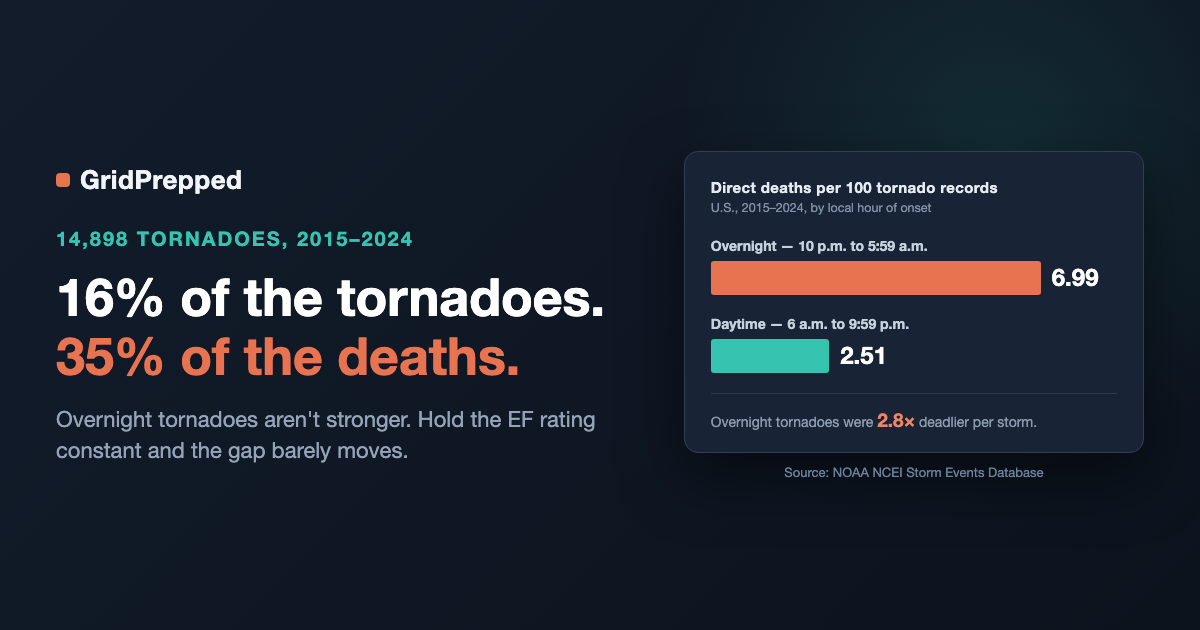
NOAA data, 14,898 tornadoes: overnight ones are 16% of storms but 35% of deaths. Same EF rating, 2.8x deadlier. Here's what to change.
On the night of December 10, 2021, the four deadliest tornado records in Kentucky's history books were written in about four hours. Graves County at 9:16 p.m. Hopkins at 10:32. Muhlenberg at 10:55. Warren County at 1:09 the next morning. Sixty-six people died across those four. Forty-two of them died in the three that arrived after 10 p.m.
That is the kind of statistic that gets filed under "tragedy" and left there. But it points at something you can actually measure — and act on.
What 14,898 tornadoes say about the clock
I pulled NOAA's Storm Events Database for 2015 through 2024 and grouped every U.S. tornado record by the local hour it began. That's 14,898 county-segment records and 480 direct deaths. Then I split the day into two bands: overnight (10 p.m. to 5:59 a.m.) and everything else.
| Band | Tornado records | Share of records | Direct deaths | Share of deaths | Deaths per 100 records |
|---|---|---|---|---|---|
| Overnight (22:00–05:59) | 2,375 | 15.9% | 166 | 34.6% | 6.99 |
| Daytime (06:00–21:59) | 12,523 | 84.1% | 314 | 65.4% | 2.51 |
Sixteen percent of the tornadoes. Thirty-five percent of the deaths. On a per-tornado basis, the overnight ones were 2.8 times deadlier. Injuries follow the same shape: 62.8 per 100 records overnight versus 36.3 in daylight.
The obvious explanation is wrong
The easy read is that night tornadoes are simply bigger. So I controlled for it — same dataset, filtered to EF2 and stronger, the ones that actually kill people.
| EF rating | Overnight share of records | Deaths per 100, overnight | Deaths per 100, daytime | Ratio |
|---|---|---|---|---|
| EF2 | 19.4% | 11.76 | 5.57 | 2.11x |
| EF3 | 20.7% | 119.35 | 51.05 | 2.34x |
| EF4 | 15.2% | 785.71 | 294.87 | 2.66x |
| EF2 and up | 19.5% | 49.07 | 22.08 | 2.22x |
The overnight share of records holds near 15–21% at every rating. Night storms aren't disproportionately strong. Hold intensity constant and the gap barely moves: an EF3 that arrives at 2 a.m. is still more than twice as lethal as an identical EF3 at 2 p.m.
Which means the variable isn't the storm. It's whether the warning reached a person who could still do something with it.
Sixteen minutes, and you're asleep
The National Weather Service is blunt about the failure mode. On sirens: "They are NOT designed to be heard inside your home or vehicle. They are not designed to be able to wake you up." The same NWS page notes that 97% of EF3–EF5 tornadoes are preceded by a warning, with an average of 16 minutes of advance notice.
So the lead time exists. Sixteen minutes is enough to get to an interior room. It is not enough to wake up, figure out what's happening, find shoes for three kids, and decide where to go. The daytime version of that same 16 minutes is a completely different amount of time, because you're already awake and already deciding.
At 1:48 a.m. on March 3, 2020, an EF4 crossed Putnam County, Tennessee, killing 19 people and injuring 87. The forecast worked. The clock didn't.
Where this actually matters
Nocturnal risk isn't spread evenly, which is the part almost nobody knows about their own address. Same dataset, states with at least 100 records:
| State | Records | Overnight share |
|---|---|---|
| Tennessee | 361 | 38.5% |
| Arkansas | 399 | 32.6% |
| Missouri | 533 | 27.4% |
| Alabama | 801 | 25.3% |
| Kentucky | 375 | 23.5% |
| Kansas | 702 | 6.8% |
| Colorado | 445 | 0.4% |
Tennessee runs a nocturnal rate 5.6 times Kansas's and roughly 86 times Colorado's. "Tornado Alley" prep advice was largely written for the Plains, where storms fire in the afternoon and die at sunset. The Mid-South is a different problem with the same name — and if you moved from Wichita to Nashville, your old instincts are now calibrated to the wrong dataset. The tornado risk lookup will tell you what your specific zip code is dealing with rather than what the regional stereotype says.
Then there's the harder version: the people you're responsible for aren't all in one zip code. Picture a daughter in a Nashville apartment — 38.5% nocturnal state — while you're in Denver, where the overnight rate is 0.4%. Your own weather is quiet. Hers isn't, at an hour when nobody is looking at a radar. GridPrepped's alert setup lets you watch up to five locations, each with its own severity setting — off, severe only, or moderate and up. You can keep your own zip on moderate and hers on severe-only so it means something when it fires, and everything arrives as one digest email grouped by the label you gave each location.
And the 16 minutes only helps if the decision is already made. A plan you have to invent at 1:48 a.m. isn't a plan. Saving yours in your GridPrepped account means the interior room, the meeting point, and who calls whom are written down and retrievable — not reconstructed while half awake. Pair it with the family dashboard so the people in other zip codes are working from the same page instead of texting "are you ok" into a dead cell site.
Three things worth doing this week
- Check your state's nocturnal share. If you're in TN, AR, MO, AL, or KY, roughly a quarter to a third of your tornado risk arrives while you're asleep. That changes what your warning method has to accomplish.
- Make sure something can wake you. A siren won't. A phone on silent won't. A NOAA weather radio with an alarm tone, or alert emails that reach a device you'll actually hear, could help close a gap that costs 16 minutes.
- Decide the shelter spot now, in daylight. Walk it. Then write it down somewhere you can find it in the dark.
None of this stops a tornado. It just moves the decision out of the worst possible hour.
Sources
- NOAA NCEI Storm Events Database, details files 2015–2024 (analysis by GridPrepped): https://www.ncei.noaa.gov/pub/data/swdi/stormevents/csvfiles/
- NWS Kansas City, "Storm Anxiety: Concerns About Receiving Storm Warnings" (siren limits; 97% EF3–EF5 warned, 16-minute average lead time): https://www.weather.gov/eax/stormanxiety-warnings
- Event details for the December 10–11, 2021 Kentucky tornadoes and the March 3, 2020 Putnam County, TN tornado are individual records within the Storm Events files above.
Build your household's emergency plan
Free, and built around where you live.