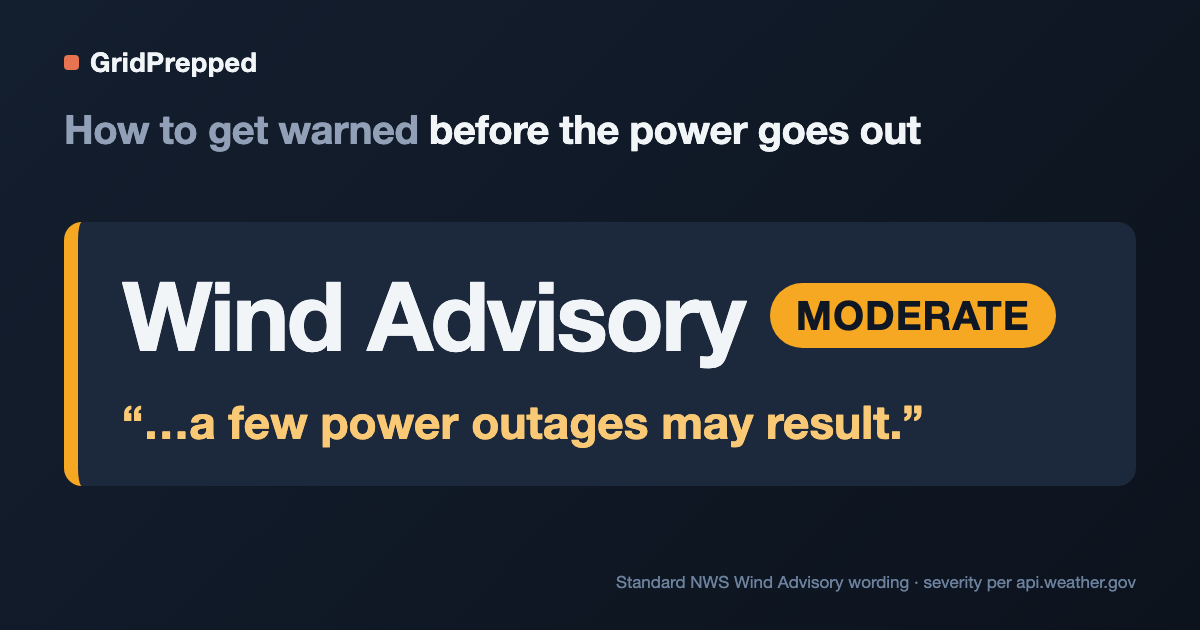
How to Get Warned Before the Power Goes Out
Phone alerts skip the warning most likely to mention outages. Here are the free sources that do warn you, and a 15-minute setup.
<!-- query: how to get warned before the power goes out -->
Most weather outages give you some notice, but not through one channel.
The heads-up comes from three places. The first is the National Weather Service, especially a Wind Advisory for your area. The second is your power company's text alerts. The third is an alert service that watches your ZIP code and emails you when a warning goes up.
The weather alerts the NWS sends straight to your phone cover only the most dangerous, imminent warnings, so the earlier warnings are the ones you have to set up yourself.
The short version, about 15 minutes:
1. Make sure emergency alerts are on in your phone's settings.
2. Turn on outage and shutoff text alerts with your power company.
3. Sign up for your county's emergency texts.
4. Get Wind Advisories for your ZIP code sent to you (free options below).
What actually warns you that the power might go out?
No one gives you a reliable outage forecast for your street. The NWS forecasts the weather that causes outages, and your utility tells you about outages it plans or expects.
| Source | What it tells you | How early | Signup? |
|---|---|---|---|
| NWS Hazardous Weather Outlook | Hazards possible in the next 7 days | Days | No (weather.gov, most offices) |
| High Wind Watch | Damaging wind possible, not yet certain | Often a day or more | No (weather.gov) |
| Wind Advisory / High Wind Warning | Wind that can bring down limbs and lines | Hours to a day or more | No, but not sent to you |
| Utility alerts | Planned or possible shutoffs | Hours to 2 days | Yes, utility account |
| Wireless Emergency Alerts | Imminent danger to life | Minutes to hours | No, automatic |
| NOAA Weather Radio | Warnings and forecasts, 24/7 | Same as NWS | Special radio |
The gap is Wind Advisories. In our sample they are the alerts that most often mention power outages, and the ones least likely to reach you unless you set them up.
Which weather alert means my power might go out?
Usually a Wind Advisory. We checked this directly.
On October 19, 2026, we pulled the latest 200 Wind Advisory messages and the latest 50 High Wind Warning messages from the National Weather Service's public alert feed. The NWS reissues an alert every time it updates one, so we counted each alert once, using its NWS event ID.
| Alert type (dates sent) | Separate alerts | NWS severity rating | Mentions power outages |
|---|---|---|---|
| Wind Advisory (Oct 16-19, 32 offices) | 37 | Moderate | 29 of 37 |
| High Wind Warning (Oct 16-17, 7 offices) | 7 | Severe | 4 of 7 |
The warning sample is small and covers fewer days, so treat it as an example, not a rate. Most of the Wind Advisories carried the same standard line: "Tree limbs could be blown down and a few power outages may result."
A real one from October 2026: on October 16 and 17, the NWS office in Mobile, Alabama issued Wind Advisories for south Alabama, northwest Florida and southeast Mississippi with gusts up to 40 mph. The text warned that the wind could down trees already weakened by Hurricane Isaias, "which would result in renewed power outages in vulnerable areas."
That advisory was rated Moderate. A filter set to severe-only would not have shown it.
What a Wind Advisory means, per the NWS wind safety page: strong winds are occurring, but not strong enough for a High Wind Warning. When you see one for your area, charge your phone and power bank tonight.
Wind Advisories are also far more common. In 2025 the NWS issued about 1,800 Wind Advisories and 620 High Wind Warnings nationwide, roughly three to one, based on our count of a public archive of past NWS warnings run by Iowa State University.
Will my phone warn me before an outage?
Usually not, and that is by design. Wireless Emergency Alerts are the short alerts that arrive with a unique sound and vibration. The NWS lists the warnings it sends this way: tsunami, tornado, the most destructive severe thunderstorms, considerable or catastrophic flash floods, hurricane, typhoon, storm surge, extreme wind, dust storm, and snow squall.
Wind Advisories and High Wind Warnings are not on that list. The system is for danger to life in the next few minutes or hours, and "your power may go out tonight" isn't that.
To make sure these alerts are on: on an iPhone, open Settings, tap Notifications, and scroll to the bottom. On Android, open Settings and search for "emergency alerts," since the menu name varies by phone.
The NWS also notes that local signup systems run by your city or county are separate from these phone alerts and add to them. If your county offers emergency text or email alerts, sign up. Search your county name plus "emergency alerts."
Is a NOAA weather radio worth it?
If your area loses power or cell service often, yes. NOAA Weather Radio broadcasts NWS warnings, watches and forecasts 24 hours a day from more than 1,000 transmitters covering all 50 states and the territories. A battery-backed receiver keeps working when the power and the internet are both down.
Look for a radio that lets you enter your county code (the box will say "SAME"). It then only goes off for warnings near you, not ones a hundred miles away.
It has limits too. A signal reaches roughly 40 miles from the transmitter, hills can block it, and some counties have only partial coverage, so check reception for yours. The receiver only works if its batteries are fresh. Test it when you change your smoke alarm batteries.
How do I get alerts from my power company?
Log in to your power company's website and turn on outage and shutoff alerts by text or email. If the bill isn't in your name, call the number on their website and ask whether you can get alerts for your address anyway.
Two kinds of messages matter for warning:
- Planned outages for repair work, often sent ahead of time.
- Planned shutoffs to prevent wildfires (Public Safety Power Shutoffs). The power company turns the power off on purpose during dangerous fire weather.
If someone in your home relies on powered medical equipment, ask your power company whether it has a program that gives those customers extra notice.
California's utility commission sets a target for its investor-owned utilities: whenever possible, notify affected customers 24 to 48 hours before a shutoff, and again 1 to 4 hours ahead if possible.
If you're a PG&E customer, account holders get these automatically. PG&E also offers Address Alerts by phone and text for other addresses you care about: a parent's home, a child's school, your work, or a rental where the landlord pays the PG&E bill. It also posts a 7-day shutoff forecast.
PG&E's own page says forecasts can shift, and the first alert may come the same day.
Outside California, check your utility's site for "outage alerts" or "power shutoff." For a full shutoff checklist, see our guide on preparing for a Public Safety Power Shutoff in 72 hours.
How to have GridPrepped watch for it
GridPrepped pulls from the same public sources above and puts them in one place.
Check any ZIP code now, no account
Live Emergency Alerts works without signing in. Enter a ZIP code and it shows:
- Active NWS alerts for that spot, sorted most severe first. Tap one to see the full headline, the NWS "What To Do" instructions, and when it expires.
- A summary of your local NWS office's Hazardous Weather Outlook for today and tonight, when the office issues one. Offices often split the outlook by area, so for your exact county, and for days two through seven, read the full outlook on weather.gov.
- Air quality from EPA AirNow, earthquakes of magnitude 2.5 or more within about 155 miles in the past week, active wildfires within 200 miles, nearby river gauges, and space weather alerts.
This page shows what is active when you look. It does not keep watching after you close it, and it does not show whether your power is out. Your utility's outage map does that.
Get an email when something is posted, free account
With a free account, GridPrepped checks the locations you've turned alerts on for and emails you a digest. What the settings do:
- Up to 5 watched locations. You can save more places, but alerts go to at most 5. Each gets a name you choose, like "Home," "Mom," or "Dorm," and a ZIP code. One is your primary.
- New locations start with alerts Off, so pick a level after you add one.
- A level for each location. Off, Severe only, or Moderate & up. Use the alert setting on each location under Your Locations; that is the one the email digest follows.
- One email covers every location that has something new, grouped by name, so five locations don't mean five emails.
- Timing. The digest runs on a schedule several times a day, and you get no more than one alert email per hour.
Set your own home to Moderate & up. In our sample nearly every Wind Advisory message was rated Moderate, so this setting catches them. The few it would miss were rated Minor as the wind was dying down. Use Severe only for places you only need to hear about when it's serious.
Here's where that matters. Your mother lives two hours away on a rural line with tall trees. A Wind Advisory goes up for her county Thursday afternoon, and she may not see it. If her ZIP is a watched location set to Moderate & up, it can reach your inbox at the next check, which may give you time to call and make sure her phone is charged and her medications are where she can find them.
You add and edit locations under Your Locations in your profile settings. The alerts dashboard shows what is active at your primary location's ZIP, and you can look up another ZIP from there.
Push notifications for the urgent ones
If you turn on push notifications, GridPrepped also checks about every 15 minutes for NWS warnings rated Severe or Extreme that are happening now or expected soon, including High Wind Warnings, at every location you watch, and sends them as a push right away. A warning sent this way won't be repeated in your email digest.
A 15-minute setup
1. Make sure emergency alerts are on. On an iPhone: Settings, Notifications, scroll to the bottom. On Android: search Settings for "emergency alerts."
2. Log in to your power company's website and turn on outage and shutoff alerts by text. If the bill isn't in your name, call and ask whether you can still get alerts for your address.
3. If your county has an emergency alert signup, use it.
4. Check your ZIP on Live Emergency Alerts, then read the full Hazardous Weather Outlook for your county on weather.gov and look for the word "wind."
5. Create a free account, add your home and set it to Moderate & up, then add up to four other places and turn their alerts on.
6. If outages are common where you live, put a battery weather radio on the list.
Together, these can turn "the lights just went out" into "we knew this afternoon it might happen," which is when charging the phone and filling the water jug still helps.
Sources
- National Weather Service alerts API, latest 200 Wind Advisory messages (October 16-19, 2026) and latest 50 High Wind Warning messages (October 16-17, 2026), pulled October 19, 2026: https://api.weather.gov/alerts
- Iowa Environmental Mesonet, NWS watch/warning archive, calendar 2025: https://mesonet.agron.iastate.edu/cgi-bin/request/gis/watchwarn.py?help
- NWS, Wireless Emergency Alerts: https://www.weather.gov/wrn/wea
- NWS, Wind watches, warnings and advisories: https://www.weather.gov/safety/wind-ww
- NOAA Weather Radio All Hazards: https://www.weather.gov/nwr/
- California Public Utilities Commission, PSPS notification guidelines (compendium as of July 2022): https://www.cpuc.ca.gov/-/media/cpuc-website/divisions/safety-and-enforcement-division/psps/psps-compendium-12-july-2022.pdf
- PG&E, Public Safety Power Shutoffs and Address Alerts: https://www.pge.com/en/outages-and-safety/safety/community-wildfire-safety-program/public-safety-power-shutoffs.html
- PG&E, 7-day PSPS forecast: https://pgealerts.alerts.pge.com/updates/7day/
Build your household's emergency plan
Free, and built around where you live.