The Grid's Summer Ended August 31. September 2 Was Its Second-Biggest Day of the Year.
Ten Extreme Heat Warnings, and September 2 was MISO's second-biggest demand day of 2026. Eight years of EIA hourly data on why September isn't summer.
# The Grid's Summer Ended August 31. September 2 Was Its Second-Biggest Day of the Year.
Ten Extreme Heat Warnings were in effect when I pulled the National Weather Service's active-alerts feed at 9:27 a.m. Mountain on September 5, 2026. They covered 267 forecast zones across Missouri, Illinois, Kansas, Kentucky, Iowa and Indiana. NWS Topeka's warning described afternoon heat index values of 100 to 108 across portions of central and northeast Kansas.
Three corrections before you plan around it. It was six states, not four. And most were short-lived: seven of the ten were set to expire that same evening and one on Sunday. Only two ran through Tuesday, September 8: Topeka's and Kansas City/Pleasant Hill's. There is also no such thing as an "Excessive Heat Warning" anymore. The NWS retired that name; the product is now an Extreme Heat Warning.
That's the forecast. The part nobody is talking about happened on the grid on Wednesday, September 2.
September 2 was MISO's second-biggest demand day of 2026
The EIA Hourly Grid Monitor balance files record every U.S. balancing authority's hourly demand. I pulled MISO and SPP, 2019 through September 3, taking each day's peak from EIA's adjusted demand series.
MISO's highest demand day of 2026 so far was June 30, peaking at 121,514 MW. Its second highest was September 2, at 119,227 MW, or 98.1% of the year's highest hour. Every hour that ranks between them belongs to June 30 itself. SPP's summer peak was 57,964 MW on July 27; on September 2 it reached 56,297 MW, 97.1% of that.
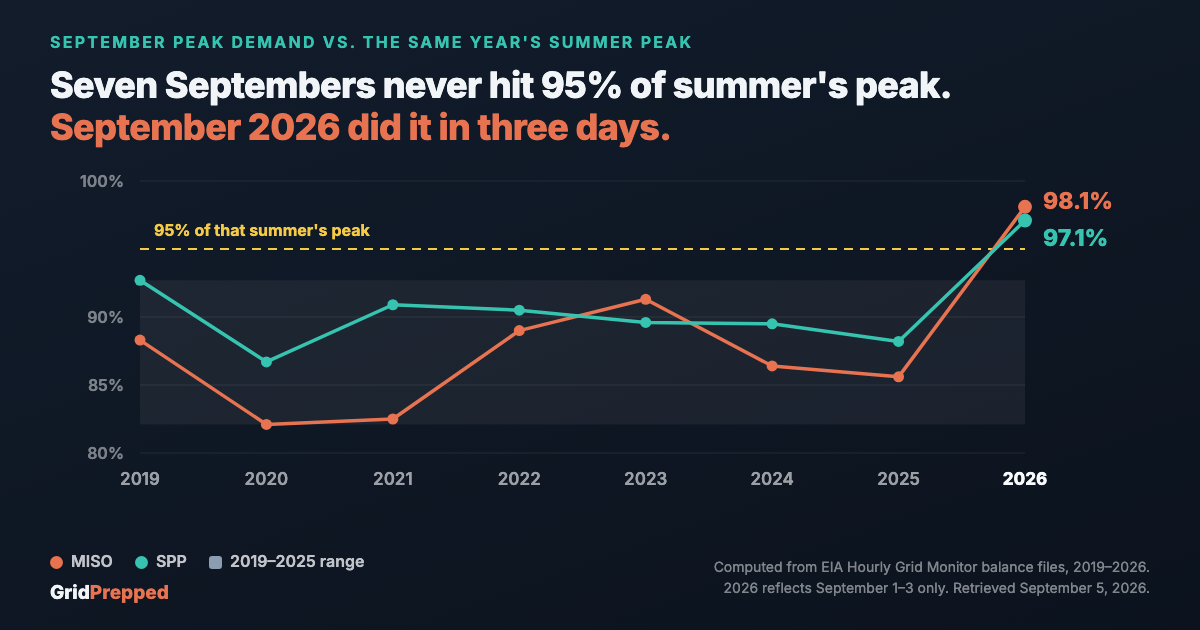
Near-peak days in September are not normal. Every September in the record, against that same year's June–August peak:
| September | MISO peak vs. summer | SPP peak vs. summer |
|---|---|---|
| 2019 | 88.3% | 92.7% |
| 2020 | 82.1% | 86.7% |
| 2021 | 82.5% | 90.9% |
| 2022 | 89.0% | 90.5% |
| 2023 | 91.3% | 89.6% |
| 2024 | 86.4% | 89.5% |
| 2025 | 85.6% | 88.2% |
| 2026 (Sept 1–3 only) | 98.1% | 97.1% |
Seven Septembers, thirty days each, two grids: 420 days. Not one of them reached 95% of its own summer peak. In the first three days of September 2026, MISO did it twice and SPP three times.
Be precise about that last row: three days, not thirty. I wrote this on September 5, and anyone reading later can check the finished month, higher or lower, against the same files. September 2 itself is settled: it beat all 420 prior days against their own summer peaks by more than five points.
The plants didn't leave. The season did.
The obvious explanation is autumn maintenance: generators go offline, so the same load bites harder. I checked, and it doesn't hold up.
The Nuclear Regulatory Commission's power reactor status report for September 4 listed just two reactors at zero power: Palisades and Dresden 2. Eighty-eight of the other ninety-three were at 95% power or better. In EIA's data, MISO's nuclear output in early September averaged 97.4% of its 2026 maximum, the strongest month since January. The refueling season is spring: in March, MISO nuclear averaged 71.2% of max. Autumn maintenance had not meaningfully begun.
What changed is the calendar the market runs on. MISO plans capacity in four seasons defined by calendar quarter. Summer is June, July and August, so summer ended August 31. The Planning Reserve Margin Requirement is the capacity that utilities must line up in advance. In MISO's own 2026/27 Planning Resource Auction results, the initial requirement is 137,922.8 MW for summer and 127,115.0 MW for fall. On September 1 that initial requirement stepped down by 10,808 MW; on the final numbers the step is 8,746 MW. The next day, load came within 2% of the year's highest hour.
To be fair to MISO, this is not a system running on fumes. Its fall reliability target is a *higher* percentage than summer's, 11.6% against 7.9%. The fall auction cleared well above it, at 16.7% effective margin in North/Central. A smaller requirement alongside a higher target points to a lower expected peak, not a thinner cushion. The margin is real, and it is sized for a September that cools off. The first days of this one did not.
What that means at your house
None of this says the lights are going out. It says treating heat risk as something that ends with Labor Day is a planning error, and the first week of September was the evidence.
The warnings don't share a clock. Ten warnings, six states, expiring between the evening of September 5 and 8 p.m. on the 8th. A family split between Missouri and Illinois sat under two of them, ending on different days. Checking a weather app address by address is how the one that mattered gets missed. GridPrepped's alerts let you watch up to five locations and set the severity threshold separately for each one: off, severe only, or moderate and up. You get one grouped digest instead of five apps' worth of pings.
Somebody in this footprint is running a window unit. Picture your mother outside Sedalia, Missouri, while you're two time zones west. Sedalia is in Pettis County, named in the Kansas City warning that ran to 8 p.m. Tuesday. The person who can actually walk over is probably a neighbor or a sibling, not you. Family plans and shared plans are built for that gap. A plan only helps if the person standing nearest the problem can open it.
Pick the cooling destination before you need it. Heat and outages travel together: an afternoon on a strained system is when a distribution failure finds you. At 4 p.m. in a house climbing past 90 degrees, "where do we go" is a question, not a plan. The person answering may be the sibling who drove over, not you. A saved emergency plan holds that answer where anyone you've shared it with can read it: the library, a relative's place, which pharmacy holds the prescriptions.
The market's calendar moved 10,808 megawatts on September 1. The weather did not get the memo, and neither should your planning.
Sources
National Weather Service active alerts API, retrieved 2026-09-05 15:27 UTC: https://api.weather.gov/alerts/active?event=Extreme%20Heat%20Warning
EIA Hourly Grid Monitor, six-month balance files (MISO and SWPP, 2019–2026), file pattern EIA930_BALANCE_YYYY_Jan_Jun.csv and EIA930_BALANCE_YYYY_Jul_Dec.csv, retrieved 2026-09-05: https://www.eia.gov/electricity/gridmonitor/sixMonthFiles/
MISO Planning Resource Auction Results, Planning Year 2026/27: https://cdn.misoenergy.org/2026%20PRA%20Results%20Posting%2020260522%20-%20Corrections754715.pdf
MISO news release, "MISO's Planning Resource Auction shows sufficient capacity for coming year" (seasonal definitions and clearing prices): https://www.misoenergy.org/meet-miso/media-center/2026---news-releases/misos-planning-resource-auction-shows-sufficient-capacity-for-coming-year/
U.S. NRC Power Reactor Status Report, 2026: https://www.nrc.gov/reading-rm/doc-collections/event-status/reactor-status/2026/2026powerstatus.txt
Build your household's emergency plan
Free, and built around where you live.