New England Homes Own Backup Generators at Nearly 6 Times Arizona's Rate
New England homes own generators at 5.8x Arizona, Nevada, and New Mexico's rate, despite real storm outages there this August. EIA data, computed.
# New England Homes Own Backup Generators at Nearly 6 Times Arizona's Rate
For most households in Arizona, Nevada, and New Mexico, the honest answer to "do you have backup power" is no. That's not a guess. It's what the federal government's own household energy survey says, and it lines up badly with what actually happens to the power grid in those three states.
On August 14, 2026, monsoon storms triggered 56 separate outage events across Clark County, Nevada, and knocked out power to nearly 5,000 customers around Laughlin, per NV Energy. Five nights later, on August 19, a dust storm with winds up to 68 mph and 714 lightning strikes rolled through Phoenix. Salt River Project reported about 17,000 customers without power in Maricopa County at the peak, with more than 1,000 more out in Pinal County. Neither made national news. Both are routine for the region.
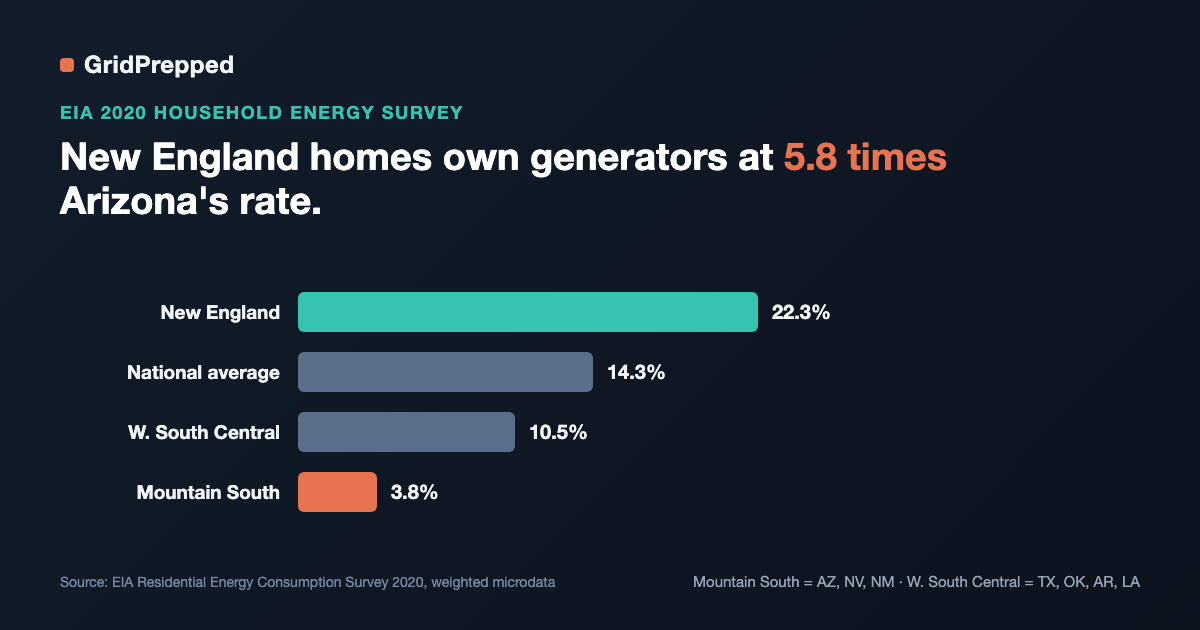
Here's the number that doesn't match: the U.S. Energy Information Administration's 2020 Residential Energy Consumption Survey, a nationally representative study of nearly 18,500 households built to represent all 123.5 million occupied homes in the country, asks whether a household owns a backup generator. I pulled the public microdata and weighted it myself. Nationally, 14.3% of households have one. In Arizona, Nevada, and New Mexico, grouped by EIA as the Mountain South census division, it's 3.8%. In New England, it's 22.3%. That's a 5.8x gap between the region with the highest ownership and the one with the lowest, and the lowest belongs to three states that just had two separate storm outages in one August.
The pattern doesn't stop there. West South Central, which is Texas, Oklahoma, Arkansas, and Louisiana, home to Winter Storm Uri and a decade of hurricane landfalls, sits at 10.5%, below the national rate. New England, which sees fewer named storms and generally shorter outages, leads the country. Generator ownership tracks something, but it isn't outage risk. It tracks income, home type, and whether you own the roof over your head. Homeowners are 2.7 times more likely to have a generator than renters (17.9% vs 6.7%), and renters make up 39.4 million U.S. households, 32% of the total I weighted.
Housing type tells a different story. Mobile homes, which showed up in an earlier GridPrepped piece as the location for over half of located tornado deaths, aren't actually the generator gap. They come in at 14.9% ownership, close to the 18.1% for single-family detached homes and well above the national rate. The real gap is apartments: 2.3% for buildings with 2 to 4 units, 9.4% for buildings with 5 or more. That's not a preparedness failure so much as a physical one. A mobile home has a yard to run an extension cord across. A fifth-floor unit doesn't.
A generator isn't the only form of backup power, and it was never going to be the plan for a third of the country anyway. A renter in a Phoenix apartment complex can't install a standby unit or safely run a portable one on a balcony. What that household can do is know exactly what it's holding when the power goes out at 9:30 p.m.: water, batteries, a charged phone bank, medication that hasn't expired. Know it before the storm, not during it. That's the gap GridPrepped's supply tracker is built to close, not a generator you don't own, but a running, dated inventory of the backup you do, so "we have some batteries somewhere" becomes an actual number.
For the 96.2% of Mountain South households without a generator, the honest planning question isn't "which generator." It's "what's my plan for the six or twelve hours until SRP or NV Energy restores service," and that's a plan worth writing down once rather than improvising at 10 p.m. GridPrepped's readiness goals walk through exactly that, sized to what you actually have, not to hardware you'd need to buy first.
There's a family version of this gap too. If you live in Boston, where better than one in five households owns a generator, and your parents live in Tucson, where it's closer to one in twenty-five, "they've got it handled" is a bad assumption built on your own zip code. GridPrepped's alerts let you watch up to five locations, each at its own severity setting (off, severe only, or moderate and up) with everything landing in one digest instead of five separate apps. Watch your own address at moderate and theirs at severe-only, and you'll actually see the storm that matters to them.
None of this says a generator would have kept anyone's lights on, and it doesn't need to. The 68-mph gusts and 5,000 dark meters weren't unusual for Mountain South. The low ownership rate is. If your household is one of the 85.7% nationally without a backup generator, that's not a problem to buy your way out of tonight. It's a reason to know what you've actually got, log in, and check.
Sources
- EIA 2020 Residential Energy Consumption Survey, public microdata (backup generator ownership by census division, weighted): https://www.eia.gov/consumption/residential/data/2020/
- AZFamily, "Wall of dust, heavy rain and power outages hit Phoenix area overnight," Aug. 19-20, 2026: https://www.azfamily.com/2026/08/20/giant-dust-storm-brings-heavy-rain-damaging-winds-phoenix-area/
- Hoodline, "NV Energy Outages Hit Clark County, Laughlin After Storms," Aug. 14, 2026: https://hoodline.com/2026/08/storms-knock-out-power-to-nearly-5-000-customers-across-clark-county/
Build your household's emergency plan
Free, and built around where you live.