Your Household Isn't in One Place. Your Alerts Shouldn't Be Either.
Watch up to five places at once, each at its own alert level, so a household spread across counties gets one inbox instead of five.
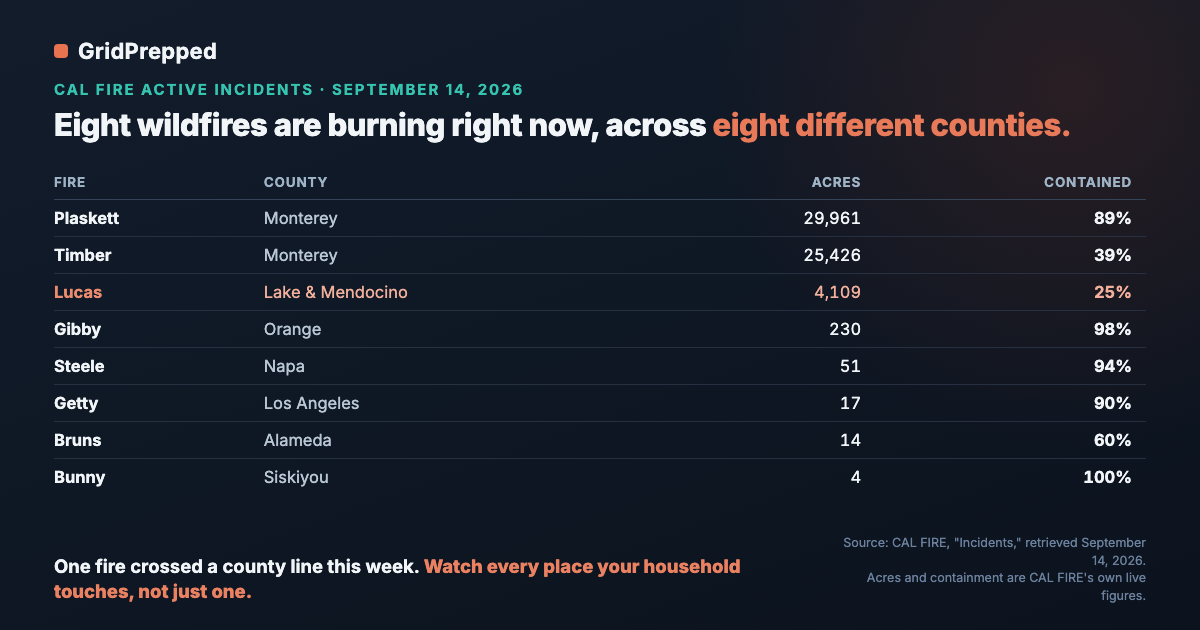
As of today, CAL FIRE is tracking eight active wildfires, spread across eight different counties. Two of them, Plaskett and Timber, are both in Monterey County and mostly wrapped up: 89% and 39% contained. The newest, the Lucas Fire, started in Mendocino County on September 10 and has since burned across the line into Lake County next door. It's now 4,109 acres, a quarter contained. Eight fires, eight counties, and nobody checks eight separate sources before breakfast to find out which ones actually touch their household.
That's what GridPrepped's alert settings are built for. The saved alert page at /dashboard/alerts lets you watch up to five locations at once, not just the one tied to your home address. Set each place separately, at one of three levels: off, severe only, or moderate and up. A quiet home zip can sit at moderate and up so you catch things early. A place you only need the big warnings for can sit at severe only. One digest email covers all five, grouped by the place it's about, instead of five separate inboxes to check. The public version at /alerts does a quick zip lookup with no account, fine for checking one place one time. The saved, multi-location version is for a household whose risk isn't sitting in one place, and it only works signed in, since an account is what keeps the settings from one visit to the next.
Risk in this country is lumpy, not evenly spread
I pulled every message FEMA's IPAWS system archived nationally over the 30 days ending September 13, the same feed that carries flash flood warnings, tornado warnings, and NWS alerts to the public. 1,605 messages went out, naming 940 distinct counties and forecast zones between them. Most of those places barely showed up. The median named place appeared twice in a month. Kane County, Utah showed up 33 times, and every single one was a real Severe Flash Flood Warning during an honest monsoon stretch from late August into early September. The busiest tenth of all named places absorbed 40% of the country's entire alert volume.
| National alert volume by place, Aug 14–Sep 13, 2026 | |
|---|---|
| Total messages sent nationally | 1,605 |
| Distinct counties and forecast zones named | 940 |
| Median times a named place appeared | 2 |
| Busiest place: Kane County, UT, all real flash flood warnings | 33 |
| Share of volume absorbed by busiest 10% of places | 40.1% |
Flash flood warnings were the single most common hazard type nationally, 314 of them in the window, ahead of tornado warnings at 171 and severe thunderstorm warnings at 64. Threaded through those were 205 Required Weekly Tests, the system quietly checking that its own pipes still work, plus another 41 Required Monthly Tests. Every one of those is a real, distinct kind of message, and that variety is why watching by place and severity together beats a single blanket setting for everywhere you care about.
That's the real shape of hazard risk in America. It's concentrated, not evenly spread. A quiet home zip code and a place like Kane County were never going to need the same setting, and neither will your kid's dorm three states over, or the county the Lucas Fire just crossed into. Watch your own address at moderate and up, since you live there and want the early word. Watch a parent's town, two states over, at severe only, so a routine advisory doesn't wake either of you but a real warning still does. Watch the county your college freshman just moved into for the first time, a place with no history of its own yet as far as your household is concerned. Watch wherever your household actually touches, at whatever level fits how much you want to know about that specific place.
A household spread across counties needs more than an inbox full of alerts, though. GridPrepped's family group at /dashboard/family, labeled "Friends" in the app, lets everyone check in from wherever they actually are. When a fire crosses a county line the way the Lucas Fire did this week, that turns an anxious guessing game about who's near it into an actual answer.
None of that answers what to do once an alert lands. A saved plan does. GridPrepped's emergency plans hold the meeting point, the contacts, and the evacuation route for a household, saved somewhere any family member can open. It doesn't matter which of the five watched places sent the alert. Whoever is closest to that county opens the same document, on their own phone, without waiting for someone else to read it out loud over a call. That includes whoever happens to be nearest that day, whether that's the parent at home, the kid away at school, or the relative two states over who just got their first severe alert of the month.
Five locations, five separate settings, one inbox, and a plan waiting for whichever place needs it. Watching one address was never going to cover a household that lives, works, and studies across several. That was true before the Lucas Fire crossed into Lake County this week, and it'll be true for whatever crosses a different line next month. Sign in, add the places yours actually touches, and give each one the threshold it deserves.
Sources
- FEMA OpenFEMA, IPAWS Archived Alerts v1, retrieved September 14, 2026: https://www.fema.gov/api/open/v1/IpawsArchivedAlerts
- CAL FIRE, "Incidents" (current emergency incident list), retrieved September 14, 2026: https://www.fire.ca.gov/incidents
- CAL FIRE, Lucas Fire incident page, retrieved September 14, 2026: https://www.fire.ca.gov/incidents/2026/9/10/lucas-fire
Build your household's emergency plan
Free, and built around where you live.