Finish FEMA's Four Preparedness Asks. Practice Starts at Five Minutes.
Ready.gov asks four things this September, and Step 4 is practice. The GridPrepped tooling for all four, starting with a five-minute drill.
Ready.gov asks four things of you this September. Be in the know. Make a plan. Build a kit. Be there for your community.
That's a good list. FEMA's Ready campaign has run National Preparedness Month every September since 2004, this year under the theme "Americans Stand Ready." The four asks are the right four. They're also the most trusted preparedness advice going, so we're not trying to improve on them. We built tooling to help you finish them. Take the asks in order.
Be in the know
FEMA's version of this one is simple. Know where to get information when you need it most, and download the FEMA App for emergency alerts.
Take that advice. Then think about how many addresses your household actually occupies on a Tuesday. You're at work in one county. Your daughter's dorm is nine hundred miles away in a hazard regime that's new to her. Your parents are in a third place entirely, and the alert that matters to them lands in a forecast you don't read. GridPrepped's alerts exist for that shape of family. You can watch up to five locations and set the sensitivity separately for each one: off, severe only, or moderate and up. You get one grouped digest instead of five apps' worth of pings. Watching your own zip at moderate and a kid's campus at severe-only is the setting that keeps you reading the emails in November.
Make a plan
FEMA is specific about what belongs in a plan, and it's the right specificity: emergency contact information, meeting places, medical information. Its expanded guidance goes further and tells you to cover everyone's real needs, including older adults, people with disabilities and pets, and to include every location you visit regularly. Home, the workplace, school or daycare, places of worship. It also makes a point most people miss, that insurance coverage may take up to 30 days to go into effect, which makes the paperwork a dry-day job.
Two GridPrepped surfaces answer this ask at two different depths.
The plan builder is the on-ramp. Three steps, no account, no email, and it comes back with a real starter plan built around the hazards that apply to your zip code. It takes a few minutes. One caveat that's ours to state plainly: a plan built without signing in lives in that browser and nowhere else, so signing in is what keeps it.
Emergency plans is the document FEMA is actually describing. Six sections, and they map almost one to one onto the campaign's list: Communication, Shelter-in-Place, Evacuation, Medical, Documents, Pets. It saves, it prints, and it shares, which matters because the person who needs to read your plan at 4 p.m. on a bad day might be your sister.
Build a kit
The kit advice on the campaign page is the practical kind. Gather supplies over time, start with what's already in the house, involve everybody, and check the kit often enough to replace expired items.
That last clause is the one that quietly decays. Water, batteries and the ibuprofen in the go bag all carry dates, and two summers later nobody remembers them. The supply tracker holds your inventory with expiration dates attached, which turns "check it often" from a reminder you have to generate into a list you can read.
Be there for your community
FEMA's fourth ask points at volunteering and at skills, and it names where to get them: a training course through FEMA's Training and Education Program, the American Red Cross, or your local emergency management agency. Do it. First aid and CPR outlast any checklist.
We built the same instinct in at household scale. Community is one of the six tracks in GridPrepped training, and the courses carry 39 family activities, written so a household works through them together rather than one person reading alone. Your household is the smallest community you're responsible for, and it's the first place any of those skills get used.
Step 4 is practice
This is the part I'd underline. Ready.gov's Make a Plan page runs four steps, and Step 4 is titled "Practice Your Plan." The instruction is "practice your plan with your household."
FEMA is right, and that step is what turns the other three from paperwork into capability. It's also the hard one to pull off alone. Practice happens when it has a date, a length, and something that reminds you.
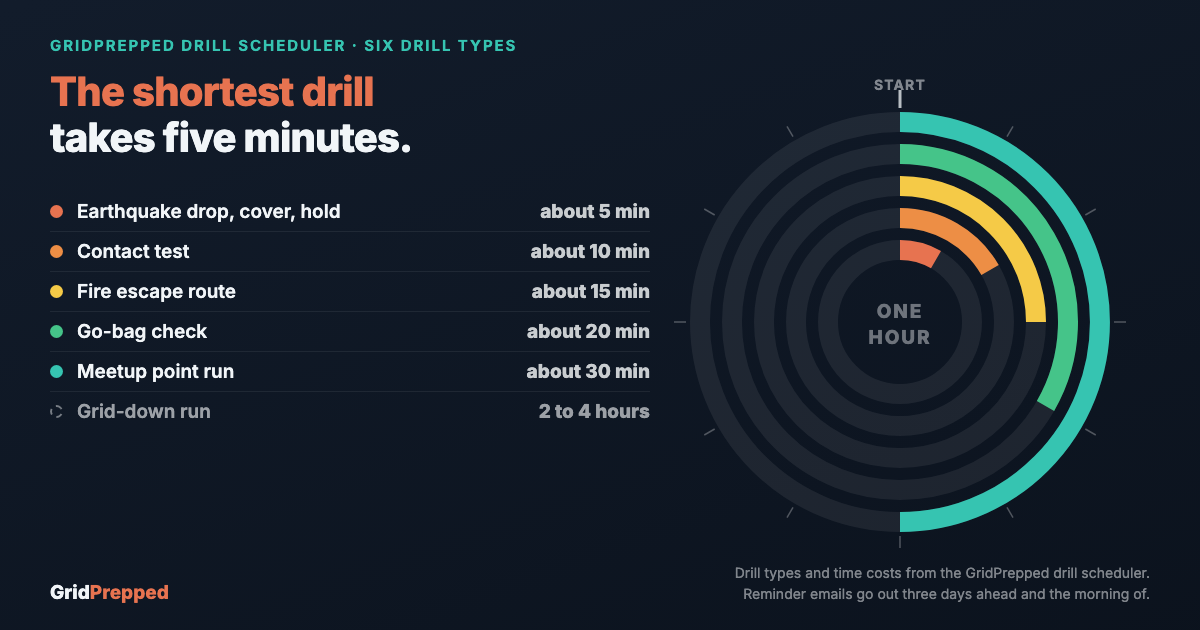
GridPrepped's drill scheduler gives all three. Six drill types, each with an honest time cost:
| Drill | Time it takes |
|---|---|
| Earthquake drop, cover, hold | about 5 minutes |
| Contact test | about 10 minutes |
| Fire escape route | about 15 minutes |
| Go-bag check | about 20 minutes |
| Meetup point run | about 30 minutes |
| Grid-down run | 2 to 4 hours |
You pick a date and it emails you three days out and again the morning of. Look at the top of that table again. Five minutes for an earthquake drill. Ten for a contact test, which is everyone in the room calling the out-of-area contact you wrote down and finding out whether that number still belongs to someone who knows they were volunteered. You can do either tonight, before dinner, with nothing wrong outside.
The practice track
If you'd rather learn the thing before you drill it, GridPrepped training runs six tracks matched to the six Grid layers, 31 modules and 127 lessons deep, with 98 knowledge checks and 31 interactive scenarios. One track is Test and Practice. Progress saves per step, so you resume where you stopped instead of restarting the module.
None of it is behind a paywall. Personal use of GridPrepped is free permanently, and the paid tiers exist for businesses and organizations.
FEMA picked the right four asks and gave September the right theme. Pick the five-minute drill tonight, and put a date on a longer one before the month is out.
Sources
FEMA / Ready.gov, "National Preparedness Month: Americans Stand Ready." https://www.ready.gov/stand-ready (retrieved September 8, 2026)
FEMA / Ready.gov, "Make a Plan." https://www.ready.gov/plan (retrieved September 8, 2026)
Build your household's emergency plan
Free, and built around where you live.