92% of U.S. Hurricane Disasters Start in the Same 92 Days. We're on Day 17, and the Atlantic Is Quiet.
FEMA records show 92% of U.S. hurricane disasters begin in Aug, Sep or Oct — and the declaration often lags the storm by a week.
This morning the National Hurricane Center published a two-sentence forecast for the entire Atlantic basin: "Tropical cyclone formation is not expected during the next 7 days."
That's the whole outlook. No invests, no cone graphics, no shaded blobs off Africa. If you only pay attention to hurricanes when something is spinning, today looks like a day off.
It isn't. It's the most useful week of the season, and FEMA's own filing cabinet explains why.
The 92-day window
I pulled every disaster declaration in the OpenFEMA database with an incident type of "Hurricane" — 454 unique declared disasters going back to 1954 — and sorted them by the month the incident began. The clustering is more extreme than I expected.
| Month incident began | Declared hurricane disasters | Share |
|---|---|---|
| July | 17 | 3.7% |
| August | 171 | 37.7% |
| September | 168 | 37.0% |
| October | 77 | 17.0% |
| November | 10 | 2.2% |
| All other months combined | 11 | 2.4% |
August, September, and October hold 416 of 454 declarations — 91.6%. Those three months are 92 calendar days. So roughly 92% of every federally declared hurricane disaster in modern American history started inside the same 92-day box on the calendar.
Today is August 17. We're on day 17 of 92.
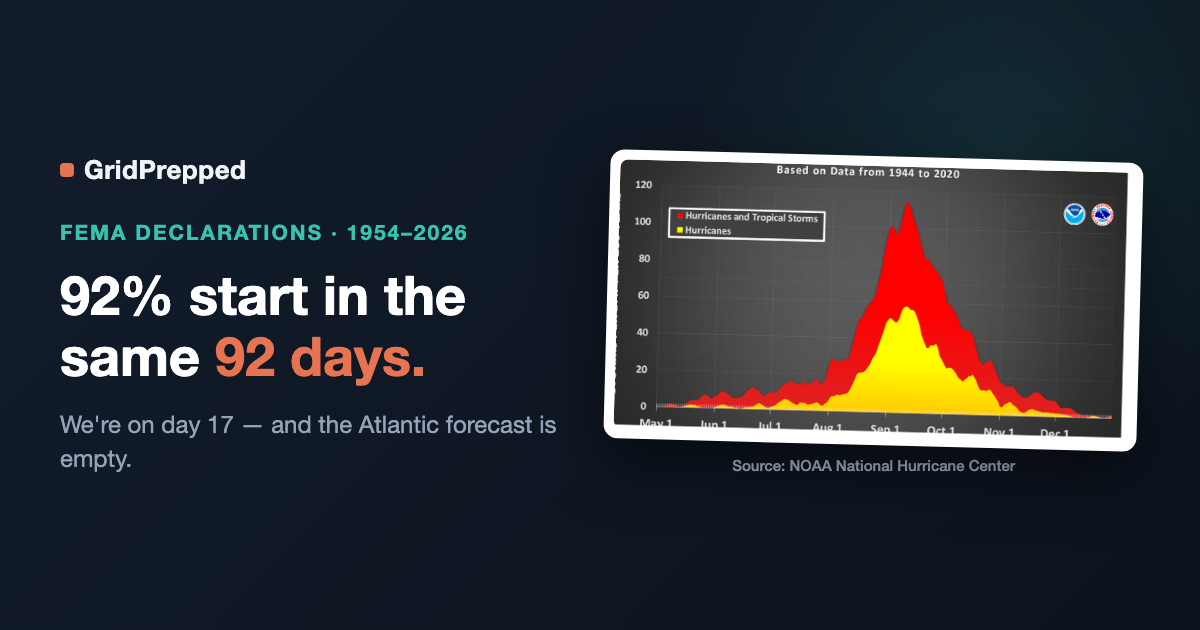
NOAA's tropical cyclone climatology page sharpens it further. Averaged over 1991–2020, an Atlantic season produces 14 named storms, 7 hurricanes, and 3 major hurricanes — and the season's *first* hurricane typically forms around August 11. The statistical peak of activity is September 10. Mid-August to mid-October is where the curve goes vertical.
A quiet forecast in the third week of August isn't the season being cancelled. It's the runway.
The number almost nobody quotes
Here's the part I actually went looking for, because it's the part that changes what you do on a Monday morning.
For each of those 454 declarations, I measured the gap between the date FEMA logs the incident as beginning and the date the declaration was actually signed. Not the response. Not the check. Just the signature that formally starts the federal machine.
- Median gap: 3 days.
- Mean gap: 11 days.
- 54.8% of declarations took 3 days or longer.
- 35.7% took a week or longer.
- For major disaster declarations specifically — the "DR" category that unlocks the bigger programs — the median is 6 days.
That mean of 11 days sitting so far above a median of 3 is the tell. Most declarations land fast, and then a long tail of them takes weeks or months, usually as damage assessments expand into counties and states that weren't in the first round.
None of this is a knock on FEMA. Declarations require governors to request, assessments to happen, and paperwork to move — that's the process working as designed, not failing. But it does mean something concrete for a household: the interval between the wind stopping and formal federal help being declared is measured in days, sometimes weeks. That interval is yours to cover.
What that looked like recently
Three storms most people remember, straight from the declaration records:
Hurricane Milton (2024). Florida's emergency declaration was signed October 7, two days into the incident period. The major disaster declaration — DR-4844 — came 31 days after the incident began.
Hurricane Ian (2022). Florida's major disaster declaration moved quickly, six days in. South Carolina's, DR-4677, was signed 57 days after its incident period started.
Hurricane Ida (2021). Mississippi got an emergency declaration the same day, August 28. Its major disaster declaration, DR-4626, arrived 55 days later.
Notice the pattern: the fast declaration usually goes to the state that took the direct hit and made national news. The slow ones go to the neighbors — the inland counties, the second state, the places that flooded three days after the cameras left. If you don't live where the eye came ashore, you're statistically more likely to be in the long-tail group.
What a quiet week is actually for
Prep done during a quiet week is cheap, unhurried, and effective. Prep done during a watch is expensive, crowded, and rushed. Same list, wildly different experience. A few things worth doing while the Atlantic is empty:
Write down your actual power-outage number. Not "a few days." Decide how many days of water, food, medication, and phone charge you intend to cover, then check whether you have it. The FEMA lag data suggests planning past the 72-hour cliché is reasonable.
Find your paperwork before you need it. Insurance policy numbers, photos of each room, deed or lease, prescription lists. Assistance applications go faster when documents already exist somewhere that isn't a flooded filing cabinet.
Fix the boring failure points. The flashlight with dead batteries. The phone charger that only works in the car you'd evacuate in. The generator you haven't started since last September.
Know two evacuation routes and one out-of-area contact. Local phone networks congest; a contact three states away often gets through when a neighbor's doesn't.
Decide who checks on whom. The single highest-value item on this list costs nothing and takes one text message.
Where a plan beats a memory
This is the specific problem GridPrepped was built for. A hurricane plan you made in your head in 2024 doesn't survive to 2026 — the medications changed, the kids changed schools, the dog is new, and the person you were going to call moved.
The plan builder walks you through the pieces above and keeps them in one place you can actually open on a phone during an outage: supply targets, medication lists, documents, routes, and who's responsible for what. Reviewing an existing plan takes a few minutes and is the highest-leverage thing you can do with a boring forecast.
The other half is timing. The households that do best in the FEMA record tend to be the ones that started moving before the watch, not after the warning. GridPrepped's alerts monitor NWS and NHC products for your location, so a watch shows up on your phone while stores still have inventory and gas stations still have lines you can tolerate — rather than being something you find out about from a neighbor.
Neither one makes a storm smaller. What they can do is shrink the gap between "something is coming" and "we know what we're doing" — and the FEMA numbers suggest that gap is where most of the pain lives.
The Atlantic is quiet this week. We're 17 days into the 92 that historically matter most. That's not a reason to worry; it's a reason to spend twenty minutes on something you'll be glad you did in September.
If you do one thing today: open your plan and check whether it still describes the people who actually live in your house.
---
Sources
National Hurricane Center, Tropical Weather Outlook, 800 AM EDT Mon Aug 17 2026
https://www.nhc.noaa.gov/text/MIATWOAT.shtml
NOAA/NHC, Tropical Cyclone Climatology (1991–2020 averages; seasonal activity peak)
https://www.nhc.noaa.gov/climo/
OpenFEMA, Disaster Declarations Summaries v2 (queried August 17, 2026; 454 unique declarations with incident type "Hurricane")
https://www.fema.gov/openfema-data-page/disaster-declarations-summaries-v2
FEMA disaster declaration records: DR-4844 (Florida, Hurricane Milton), DR-4677 (South Carolina, Hurricane Ian), DR-4626 (Mississippi, Hurricane Ida)
https://www.fema.gov/disaster/declarations
Build your household's emergency plan
Free, and built around where you live.