California Waited 1,282 Days for Its Last Big Earthquake. It Still Got Zero Warning.
USGS data on 55 years of California earthquakes shows quiet stretches up to 1,929 days. None of them came with a warning.
The 1,282-Day Quiet Spell That Just Ended
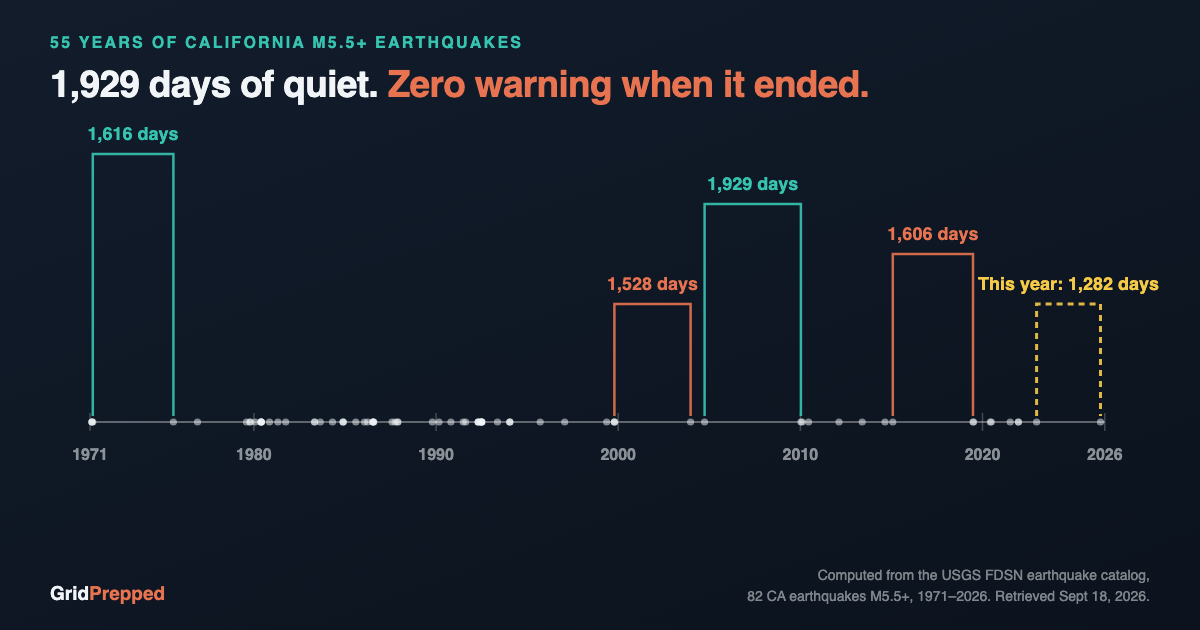
On June 24, 2026, a magnitude-5.59 earthquake hit eleven kilometers north of Redwood Valley in Mendocino County. It made almost no national news. But in the U.S. Geological Survey's own earthquake catalog, it closed out the fifth-longest stretch without a major earthquake anywhere in California in more than half a century: 1,282 days, three and a half years, since the last one.
Nobody saw it coming, because nobody can, and that's the whole case for keeping an evacuation kit ready on its own schedule rather than a hazard's. GridPrepped's evacuation kit tracker exists for exactly that gap between "quiet" and "over."
Fifty-five years, eighty-two earthquakes, no pattern
I pulled every magnitude-5.5-or-larger earthquake located in California from the USGS's public earthquake catalog myself, 1971 through today. That's 82 earthquakes in 55 years, one every 245 days on average. The median gap is 98 days, a little over three months.
Averages hide the real shape of it. Gaps range from the same week to genuine multi-year silences. The longest on record: 1,929 days, five years and three months, between the September 2004 Parkfield earthquake and a 2010 quake near Eureka. Four more stretches ran past 1,250 days, including the one that just broke this June.
| Quiet stretch | Length | Ended by |
|---|---|---|
| Sep 2004 → Jan 2010 | 1,929 days | 2010 Eureka earthquake |
| Feb 1971 → Aug 1975 | 1,616 days | 1975 Oroville earthquake |
| Jan 2015 → Jun 2019 | 1,606 days | Petrolia-area earthquake |
| Oct 1999 → Dec 2003 | 1,528 days | 2003 San Simeon earthquake |
| Dec 2022 → Jun 2026 | 1,282 days | Redwood Valley earthquake |
Parkfield is the sharpest illustration of why none of this is forecastable. That segment of the San Andreas produced magnitude-6 earthquakes in 1857, 1881, 1901, 1922, 1934 and 1966, close enough to a 22-year rhythm that the USGS built a decades-long research program around it, wiring the fault with some of the densest earthquake instrumentation on the planet and expecting the next rupture "before 1993." It arrived in September 2004, eleven years past its own forecast. If the best-monitored fault segment in the country can miss its own prediction by over a decade despite two decades of dedicated equipment, nowhere else is getting a heads-up either. The USGS states this plainly, not as a hedge but as the position of the whole field: "Neither the USGS nor any other scientists have ever predicted a major earthquake. We do not know how, and we do not expect to know how any time in the foreseeable future."
The same 55-year window holds other familiar names. The 1989 Loma Prieta earthquake and the 1994 Northridge earthquake both sit inside this record, each preceded by a quiet stretch under two years, nothing like the multi-year gaps in the table above. Long and short gaps end the same way. Nothing in the length of the silence beforehand told anyone which kind was coming.
The gap is the risk, not just the earthquake
Compare that with the wildfires that crews were still working in Monterey County this month: those came with days of containment updates and staged evacuation warnings before any order to leave. Earthquakes skip all of it. No watch, no advisory, no countdown. Quiet, then shaking.
That's why a go bag can't be a wildfire-season or hurricane-season project. The evacuation kit tracker lets you build and date one on your own schedule, so it's already packed whether the next quake lands in three months or three years. It doesn't ask what season it is, because this hazard doesn't recognize one.
If you're unsure whether your zip sits on ground the USGS actually rates as high-hazard, /earthquake-risk answers that directly, and it's worth checking regardless of how long it's been quiet where you live. The record above says that number means less than it feels like it should, and the same logic holds outside California too. Every fault zone in the country has its own version of this table, and none of them come with a countdown either.
A plan written down in advance also removes the one decision an earthquake never gives you time to make in the moment: who does what. A plan saved to /dashboard/emergency-plans stays put and readable by everyone you've shared it with, on day one of a quiet stretch or day 1,282.
What to do with a number like this
Three things come out of pulling this record. Don't read a long quiet spell as a shrinking risk. It isn't; every length of gap in the table above ended the same way, without notice, whether the wait was three months or five years. Separate kit-building from the calendar; September belongs to wildfire and hurricane headlines, but earthquakes never signed up for a season and won't wait for one to check your kit again. And check the ground you're actually standing on, rather than the calendar on your wall. A five-year gap in your area's history could mean the smallest fault ever felt, or it could mean you're standing on the next Parkfield, and the gap length itself won't tell you which.
None of this requires believing an earthquake is coming soon. The data says close to the opposite: after 55 years and 82 earthquakes, there's still no way to know. Decades of looking for a reliable precursor, strain gauges, radon readings, even reported animal behavior, haven't produced one that holds up. That's not a gap in the instruments. It's the argument for building the kit and writing the plan before either one is due, on whatever day of whatever year that turns out to be.
*California earthquake data pulled from the USGS FDSN event catalog (magnitude 5.5+, 1970–2026) on September 18, 2026.*
Build your household's emergency plan
Free, and built around where you live.